 Written by
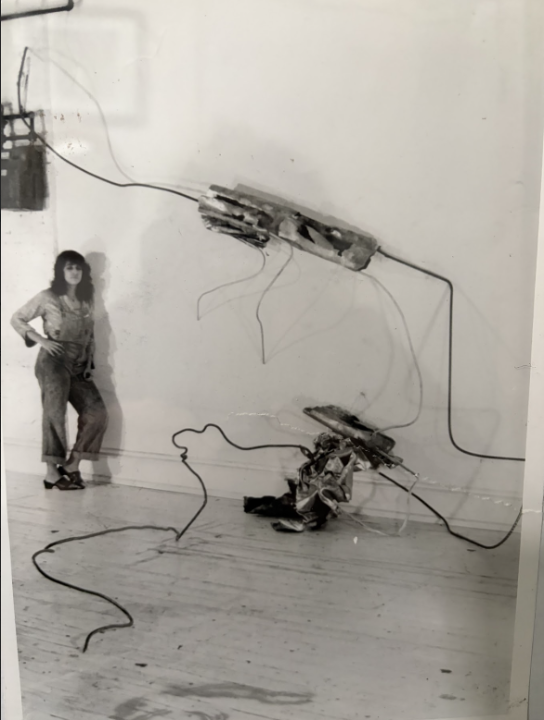
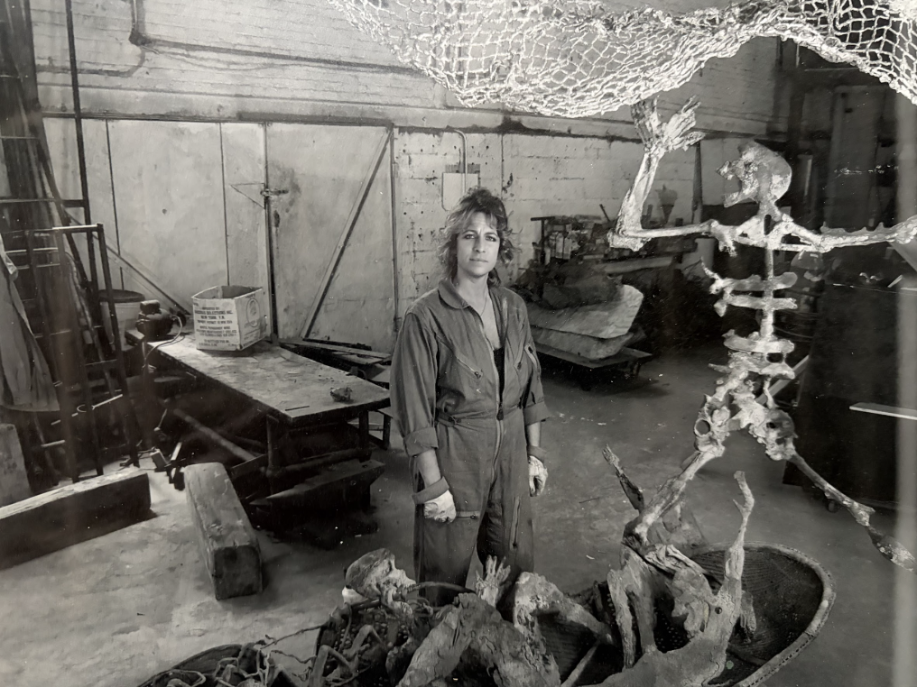
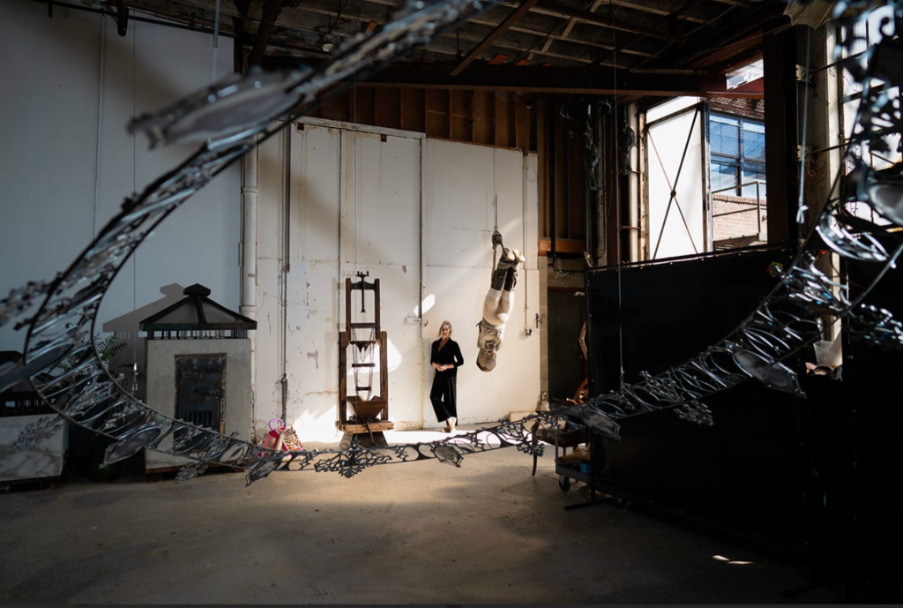
 Siona Wilson, professor of art history at the College of Staten Island and the Graduate Center, CUNY, in conversation with Marsha Pels (b. 1950; Fig. 1) about her evolution as a pioneering feminist sculptor, her artistic mentors, and her engagement with political violence, past and present.
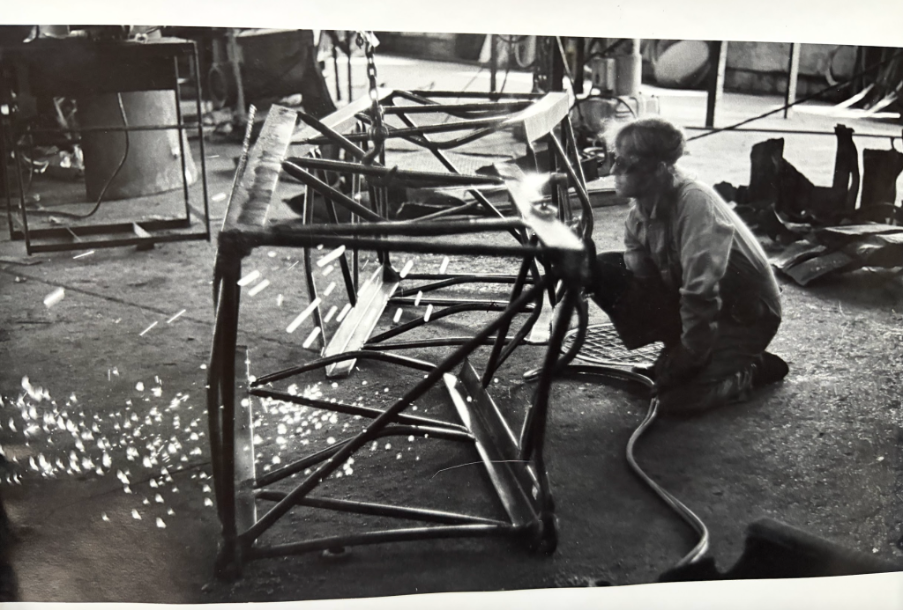
Siona Wilson: Your work fits within the idea of the lost “Generation 2.5” in feminist art described by artist and writer Mira Schor [b. 1950] in A Decade of Negative Thinking: Essays on Art, Politics, and Daily Life [Duke, 2010]. This is the forgotten generation that falls between the canonized figures of 1970s feminist art (the 2.0’s) and the next generation (the 3.0’s). This insight is helpful in many ways, which we can get into later. But first, can we talk about your relationship to feminism? You came of age as a woman and you became an artist during the height of the second-wave Women’s Movement, but you didn’t identify as a feminist until later. Can you explain your resistance during the 1970s?
Marsha Pels: Actually, I didn’t have resistance to the feminist movement in the seventies. My trajectory in feminism is interesting, because it wasn’t a smooth one, but a back and forth, so to speak. As an undergraduate at The Rhode Island School of Design [RISD] (1970–72), I made an unconscious transition from painting to sculpture at the end of my senior year and fabricated a classic feminist piece completely instinctually.
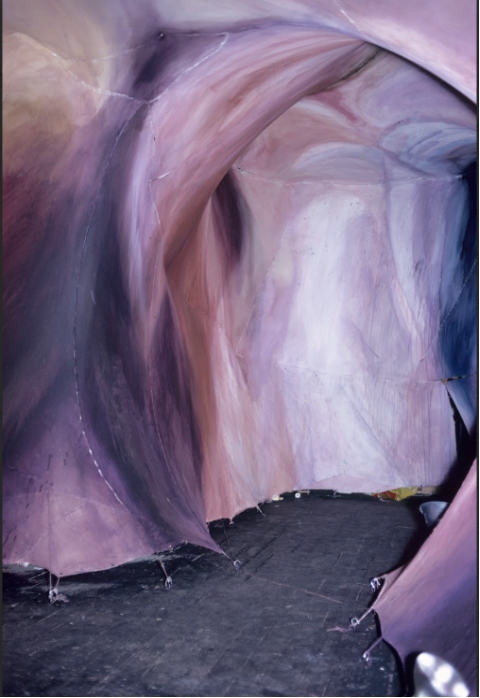
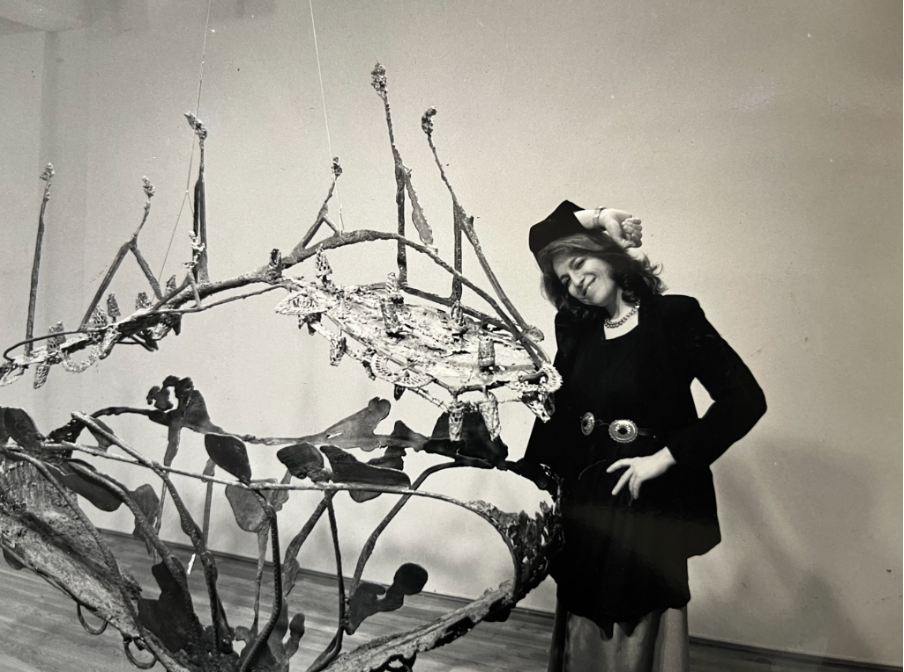
Throughout my 1,500-square-foot studio in downtown Providence, I hung, stretched, and sewed canvas into a tensile structure, and painted the inside in pulpy, watery pinks and blues and bloodied reds. I titled my first sculptureTent (Fig. 2). My all white, male, RISD Senior Thesis Committee nicknamed it A Womb with a View. It was my own Womanhouse, but I was unaware of what Judy Chicago [b. 1939] and Miriam Schapiro [1923–2015] were doing across the country at California Institute of the Arts (CalArts) in 1972, the same moment in time.
SW: What norms of sculptural practice were you educated with and how has your practice evolved in tension or relation to these?
“I had seen Eva Hesse’s No Title (1970) at The Whitney Museum in 1970, and it blew me away. Hesse’s sensibility and process gave me permission to work with sculpture in a non-traditional way.”
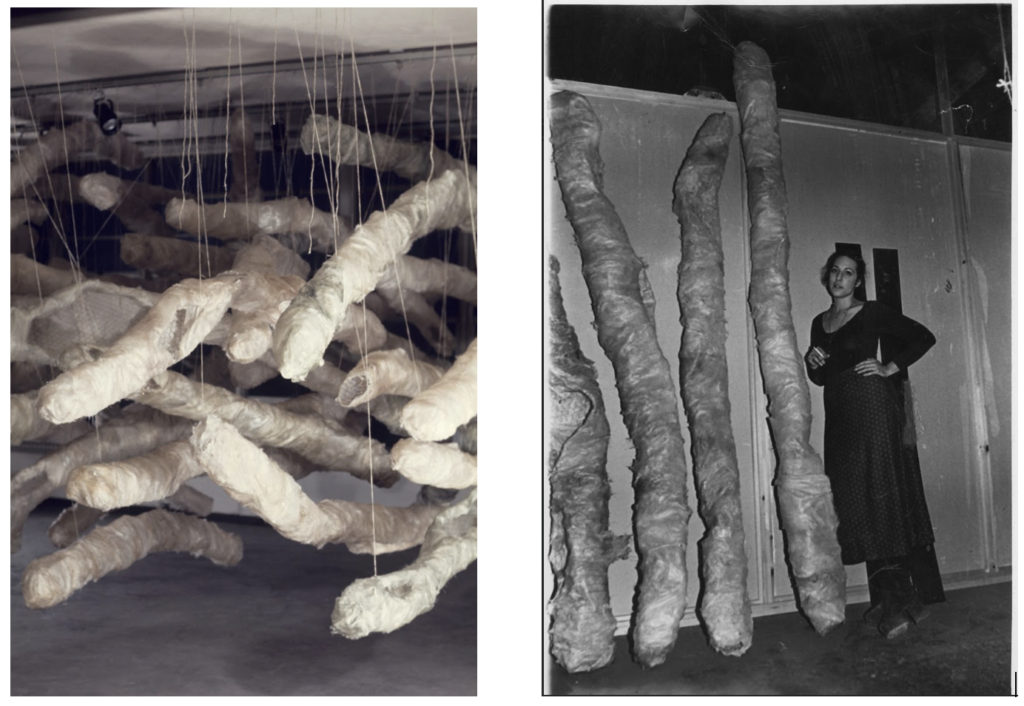
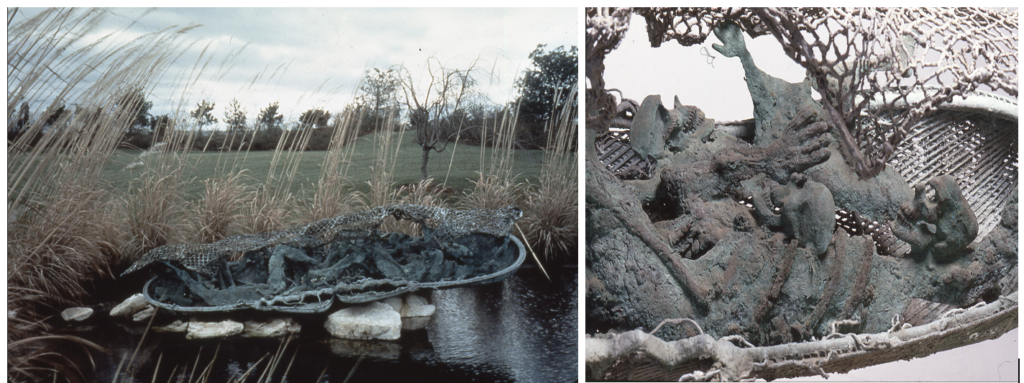
MP: After RISD, I did my graduate studies at Syracuse University (1972–74). Syracuse was a haven of formalism, with Clement Greenberg and Antony Caro as the critic and sculptor whose ideas founded everything we were taught. I continued to make feminist forms (vaginas, penises, wombs, etc.) in varied materials, from fiberglass to cast metal. It was total DIY exploration, research and development. I had seen Eva Hesse’s No Title (1970) at The Whitney Museum in 1970, and it blew me away. Hesse’s sensibility and process gave me permission to work with sculpture in a non-traditional way. Chimera (Figs. 3–4) was my graduate thesis project. After graduating, I moved to the Lower East Side, then SoHo, where I continued to reject the formalist agenda that had suffocated me at Syracuse. I also took a ‘sabbatical’ from feminism. When I moved here (I hate to say), there was so much bad feminist sculpture. It was considered ‘Essentialist’ and made of natural materials alluding to the body without any structural or aesthetic rigor. I couldn’t stand any of it and didn’t want to be associated with this movement.
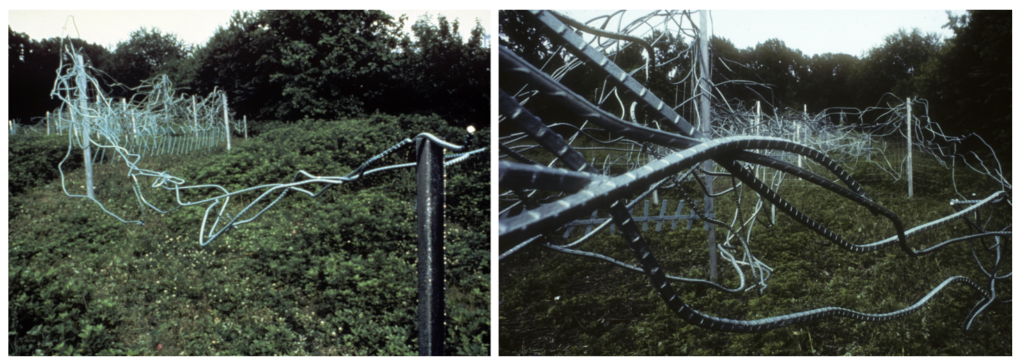
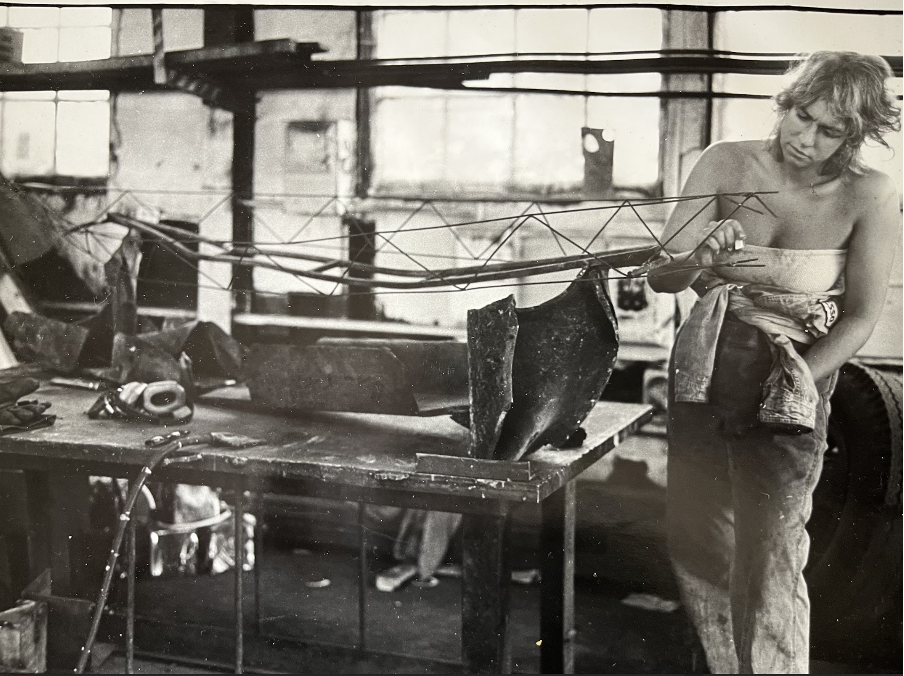
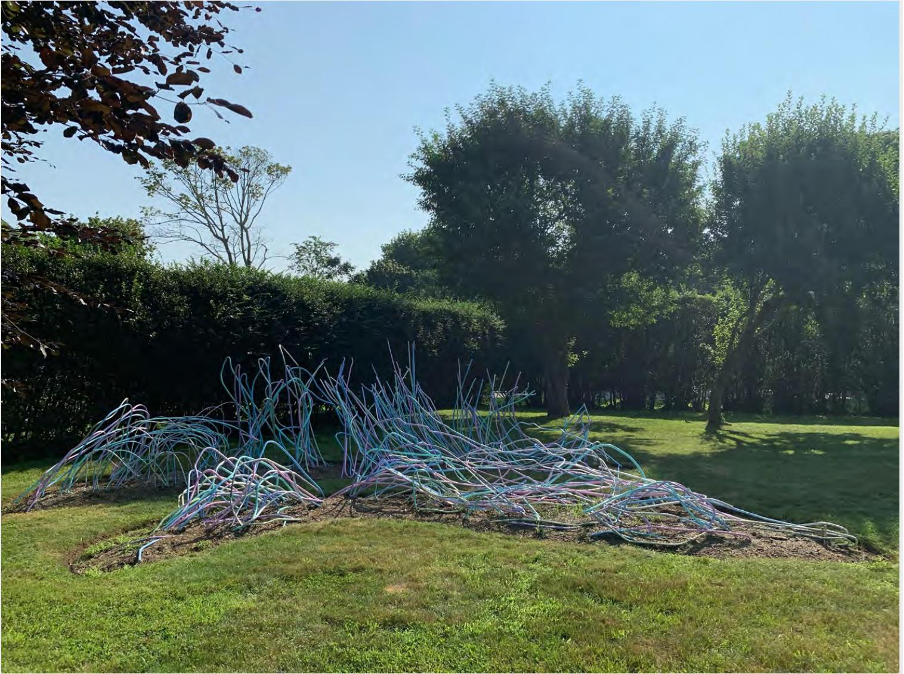
During the following decade (1974–84), I was only concerned with craftsmanship and expertise, honing my understanding of materials and techniques while finding my own voice in welded steel and cast bronze. Being thrust into the city without the comfort, tools, and facilities of school compounded my realization I had no sculptural training. I began to make monumental steel sculptures (30 to 350-foot long) in welded steel rebar (see Figs. 5–6).
SW: What’s rebar?
MP: Linear steel rods as support in concrete used during highway and building construction. I’m basically a found object sculptor. They were taking down the structure of the West Side Highway and I fell in love with the tons of destroyed rebar there. I’d hire big trucks to bring the rebar to the grounds of the group shows and then weld site-specifically. It was cheaper to pay for the truck than pay for the price of the steel.
I was “drawing in space,” to paraphrase artist Julio González. I welded steel very gesturally and painted it in pastel and metallic colors. This period of my work was considered “feminine” (not feminist) by my male peers, because it wasn’t in the primarily hard-edge Caro-esque tradition, as most welded-steel sculpture was in those days. In this way, I began to make a name for myself (Figs. 5–9).
SW: What brought you to feminism as a political and artistic identity in the 1980s?
MP: This was the death of my dear friend, Ana Mendieta [1948–1985], in 1985. I had won a Prix de Rome for Sculpture in 1984, from the American Academy in Rome, right after Ana [won her fellowship, in 1983], so we became close in Italy the last year of her life. I was waiting for her the morning after she died. She called me very upset the night before, asking me to help her move out of her husband Carl Andre’s apartment back into her own.
“I had been living a strictly feminist life, but I couldn’t call myself a feminist until Ana was pushed out of that window on September 8, 1985.”
There I was on Prince Street in SoHo, in my trusty pickup truck with a friend I had hired to help her move. We waited over three hours and finally I left an angry note: “Where the hell are you? And you couldn’t even call me?” When I got back to my Red Hook loft, sculptor Mary Miss [b. 1944] called, saying, “Marsha, Ana’s dead. She fell from Carl’s balcony.” I was in shock.
I had been living a strictly feminist life, but I couldn’t call myself a feminist until Ana was pushed out of that window on September 8, 1985.
SW: Did you participate in the trial?
MP: Yes, I testified on Ana’s behalf as a witness to her severe acrophobia. At the trial, it was so upsetting to see the art world fall in line with Carl. Many of the famous feminists I admired backed him. I witnessed the power hierarchy between the sexes. The defense pictured Ana as a demonic Santeria witch, while Carl sat there, the epitome of the canon of white male ARTGODLINESS, unemotional and smug as shit.
Two weeks before she died, Ana and I were celebrating (before I returned to NY), by spending a long weekend on the Isle of Ponza. It was late August (Ferragosto) when all Italians went on vacation and Rome, amongst other cities, became a ghost town. We were visiting my photographer (Attilo Maranzano) who had rented a house on top of the mountain on the island. There was only a thin donkey path to get there, with giant boulders and tall, thorny cactus on one side, and a deathly drop into the cerulean blue Mediterranean on the other.
I had started up the treacherous path and heard screaming. I turned to see Ana at the bottom of the hill, panicked, shaking and crying, “I’m an acrophobiac!! I can’t do this!” As I went down the hill, she stopped shaking and froze. It took an hour to calm her down. There is no fucking way she was dancing naked on the high ledge of Carl’s terrace and fell to her death as they “claimed.” He killed her. They were fighting. He picked her up (she barely weighed one hundred pounds) and threw her over his balcony.
SW: Did Ana’s work impact your work as an artist?
MP: Her work didn’t impact me at all. We were very different sculptors working in very different ways with a mutual respect and admiration for each other. We shared autobiography as an impetus for our work. We had loads of fun talking and arguing with each other. She asked me many technical questions.
It was her life and tragic death which impacted my work, not her work. Right after her death, I began a few sculptures about her relationship with Carl. During the two years I worked on Acheron, a large cast bronze sculpture, my investigation into the Holocaust began. In 1985, while in Rome, I took a journey to Emden, Germany, the town of my paternal ancestors. Acheron became a memorial merging the personal with the political, honoring my friend and the six million Jews who died in the Holocaust. In Greek mythology, ‘Acheron’ is the term for one of the tributaries between heaven and hell. It’s the major river through which the ferryman travels from Hades bringing souls from above to below (Figs. 10–12).
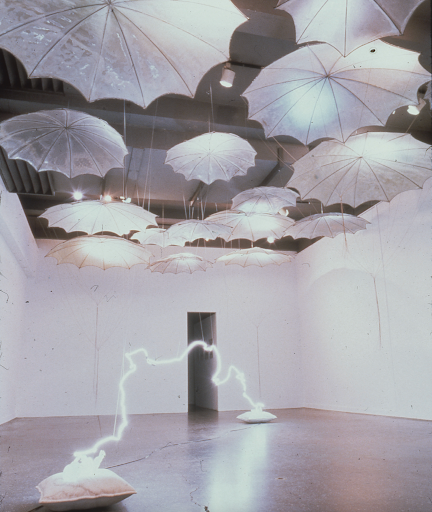
A decade after Acheron, in 1995, I made the site-specific installation TERRANOVA (Fig. 13) for The Sculpture Center in New York. Since this sculpture was about my recent miscarriage, there was no denying the progression of feminist concepts within my work after Ana’s death. Everything evolved intensely from 1985 to 1995. I’m thrilled that I’m recreating the installation thirty years later at my gallery Murmurs in Los Angeles [TERRANOVA, March 21–May 2, 2026].
SW: Could you say something about the other woman artist in your life at this time, Louise Bourgeois [1911–2010]?
MP: I was twenty-three when I finished graduate school and went to live on the Lower East Side. I had no female professors during my six years of college. I contacted Louise because of a bet with a boyfriend. He told me about “The Dewar’s Fairy,” a ritual created by his mother. When he and his siblings had their teeth pulled, she would say, “Put a wish under your pillow,” and then give them shots of Dewar’s for the pain.
He proposed that we drink a bottle of Dewar’s and put the name of the sculptor whom we would like to meet under each other’s pillow. Then, we had to call the artist and introduce ourselves. When we woke up the next morning, I had David Smith’s name under my pillow, and he had Eva Hesse’s name under his pillow. We were so drunk that it took us a few days to realize they were both dead!
A week passed and we attempted the game again. This time under my pillow was Tom Doyle and under his was Bourgeois. So, I chose Louise as my mentor. I thought she was the greatest living sculptor, and it was important that she worked within the European tradition, something I, as an American, aspired to.
“Louise showed me what it meant to be a sculptor. She modeled the concepts of what it means to live and work as an artist that persist within me to this day.”
Louise [Bourgeois] showed me what it meant to be a sculptor. She modeled the concepts of what it means to live and work as an artist that persist within me to this day.
At this time (1974), Louise wasn’t well known. If you said “Louise,” everyone thought of Louise Nevelson [1899–1988]. Madame Bourgeois was “the other Louise.” She was the most intelligent person I had ever met and, at the same time, the most abusive. All of Louise’s relationships were complicated. She would manipulate her friends against each other, not only to have power over them, but to test their loyalty to her. It was ‘cat and mouse’ most of the time. She suffered from the “Prostitute/Madonna” complex, replaying her childhood trauma between her Mother and “The Nanny,” her father’s mistress, Sadie.
I’d arrive on the steps of her Twentieth Street townhouse with some of her favorite things: eucalyptus leaves, Cointreau, dark chocolates. She’d open the door and greet me lovingly as her mother (The Good Mother), but at any moment during the day, her demeanor drastically changed, and I became the evil Sadie. Sometimes, I sensed it coming on, sometimes it hit me by total surprise. Sometimes, she hit me or threw the flowers at me after she had dramatically arranged them in a beautiful vase. Louise was also bizarrely jealous of me, accusing me of sleeping with men she liked. In 1978, after spending four years with Louise, I went into therapy. She was “Freud’s Daughter,” after all!
SW: Yes, that’s hilarious!
MP: When I came into the picture, in 1974, she had recently lost her husband, Robert Goldwater. She was lonely and needed companionship. When we went anywhere, everyone thought I was her daughter. There were a lot of taxi rides with famous feminists, from uptown to downtown. I saw her more than once a week, sometimes a few days consecutively if we were dumpster diving, taking abandoned materials from the streets and lots all over the boroughs, including New Jersey. Louise loved my pickup truck. I had to lift her in and out of it. She taught me (her vision of) art history, she gossiped a lot. I’d accompany her to openings. We ate smoked salmon and lemon meringue pie in all her favorite haunts. We’d go shopping and once spent weeks looking for the perfect Navy Blue cashmere beret. I’d take her uptown to Saks or Bergdorf’s, but we’d end up on St. Mark’s Place, in all the trashy boutiques and S&M shops. Louise would buy chain mail vests, fishnet stockings and vinyl miniskirts. To hell with that beret!
SW: Did you ever work as her assistant?
MP: No, I never worked for Louise, besides, she had Mark [Setteducati] set up in the basement, a very talented student of hers who became a famous magician. The first day I met her, she looked at my slides, then she stared at me searingly in the eye and declared, “You’re a real artist. Never work for another artist.” Just one of her many mantras I took seriously.
After her retrospective at MoMA [Nov. 3, 1982–Feb. 8, 1983], everyone wanted a piece of her, and our relationship started to drift apart. She didn’t need me in the same intimate way. Jerry [Gorovoy] had come into her life, thank god! It had also gotten so weird between us, I remember that I, too, pulled away. I interviewed her again, in 1986, because she still wanted me to write a book of our conversations. Louise remained an important part of my life into the early ʼ90s, visiting me in my Greenpoint studio numerous times. I feel her presence, looking over my shoulder right now, in the same studio, as we speak.
SW: This was when she was getting involved with the A.I.R. Gallery?
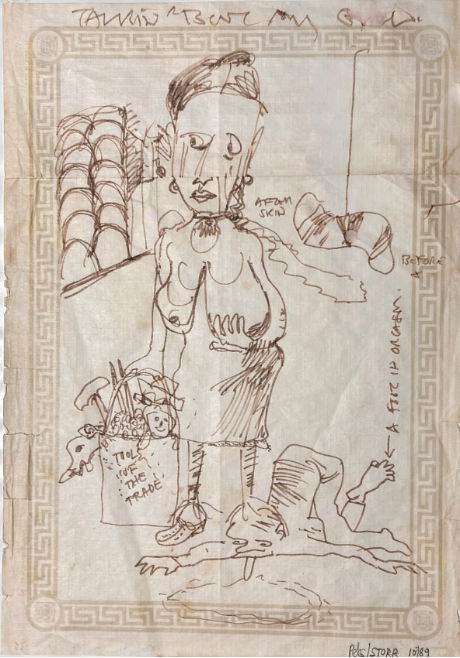
MP: Yes, Louise would declare, “I’m not a feminist. I’ve never been a feminist.” She’d make her little pouty Parisian face pursing her lips and go, pfft. To her close friends, dismissively, she’d declare, “That has nothing to do with me.” But the feminists seduced her and, suddenly, she was their poster girl for the movement. She begrudgingly accepted, and then enjoyed the attention. Louise loved being the center of attention (Fig. 14).
SW: Yet so much of what she did resonated with the Women’s Movement. The destruction of the father, these incredible objects—the treatment of the breast, the cages, not to mention the childhood trauma of being caught between her mother and her father’s mistress, Sadie, which was such a powerful anchor for her work.
MP: Yes, of course it did. Being grounded in her autobiography was one of the things that drew me to her in the first place. She gave me the courage to do so in my own work. But she didn’t want to be judged as a woman artist. She just wanted to be judged as an artist. The artists she was closest to were Marcel Duchamp and Jose de Creeft. They’d hang out in the bars on Fourteenth Street. I don’t remember Louise ever mentioning feminism the entire time I was close to her.
SW: Obviously, we see this happening with many women. And amongst feminists there can also be hostility toward other women. In your work, you are aware of these complexities. You have addressed women’s complicity (which we will talk about more later).
MP: I have no idea what kind of sculptor I would’ve been if I didn’t spend those many formative years with her. She taught me what was important to think about in the life of an artist. But it did confuse my relationship to feminism.
SW: Yet you did not come out of that being an abusive woman to other women. There is this very clear sense of a personal ethics that underpins how you relate to people in the world, which underscores your approach to the art you’re making as well.
When we first talked at length, I brought up the idea of a morality underpinning your work. I know that it’s an old-fashioned term, but it’s something that I see as distinct from moralism, which involves judgment. It seems that morality is a useful idea to bring back at this time when so many people are celebrating abusers, and even, especially right now in this country, putting them into the highest public office!
MP: Absolutely.
SW: Anyway, back to the other question that came up for me reading Mira Schor’s essay, “Generation 2.5.” She talks about the ways in which these artists do not quite fit with the dominant tendencies in the art world of a particular decade (and she includes herself, as well as figures such as Maureen Connor [b. 1947], Jana Sterbak [b. 1955], Judith Shea [b. 1948], Nancy Davidson [b. 1943], Rona Pondick [b. 1952], Kiki Smith [b. 1954], and Nancy Bowen [b. 1955], to reference some of the sculptors). Yet she talks about how there is a relationship to the dominant ideas of the period, but it is offbeat or out of time, it takes an aspect of these norms and does something quite new. I feel like your work has an off-beat relationship to the idea of “appropriation art,” to the use of language (Conceptual art), to Land art, to Public art, and even to the notion of performance or performativity. How do you relate to these categories?
MP: When I first read Mira’s essay, I knew she was describing my own experience, which I had tried many times to put into words, so I was profoundly grateful. There’s a sentence from her essay I’d like to quote:
The hybridity created by our progress through the history of the feminist art movement is the mark of a living synthesis versus a synthetic synthesis of an established menu of already predigested choices whose initial radicalism has often been significantly altered and even willfully distorted by subsequent historicizations. 1
It’s this idea of a living synthesis that I identify with, rather than a synthetic synthesis.
SW: I guess the synthetic relates to the way that art history and art criticism create neat categories out of diverse practices. Whereas a living synthesis suggests a more dynamic and unpredictable shifting practice, the synthetic synthesis disregards the work that doesn’t fit with its norms. So, you were out of time with feminism, and you didn’t fit these categories!
MP: I didn’t even fit in with the offbeat “2.5.” I was an outlier never fitting in anywhere.
SW: So, I guess you’re off off-beat, or, doubly out of time. But I still see that your work has an interesting and oblique relationship to certain dominant categories, such as “appropriation” art. Or your use of language, which we usually associate with Conceptual art, but you are using it very differently, and even to the idea of performance or performativity. How do you relate to these categories?
MP: I don’t feel comfortable with the term “appropriation” because it’s taking something from the culture and not necessarily transforming it. Yet one of my most seminal pieces is the photograph of me dressed as Hitler, I Like Germany and Germany Likes Me (2001; Fig. 15). Here, I do appropriate the image of Hitler. It’s also a performance: I copy his stance and his gestures. I had to inhabit Hitler. I was getting into his mind, so I had to get into his body as well.
SW: I feel that your self-portrait as Hitler was a different take on appropriation. It’s witty, dangerously witty, and personally invested, not the cool, emptiness of the sign.
MP: With appropriation art, there’s this distance.
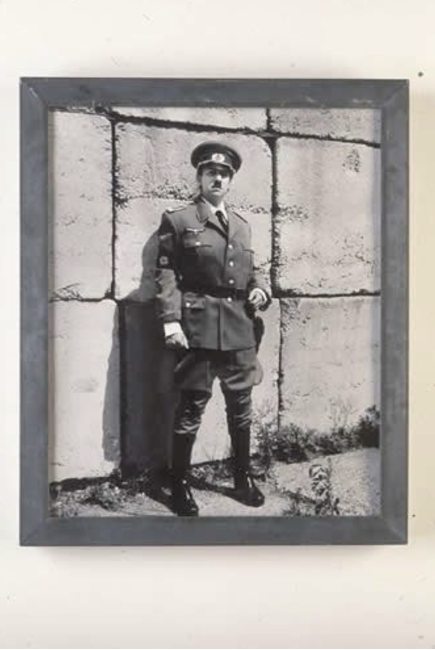
SW: For me, it has a relationship to someone like Cindy Sherman [b. 1954]. But, unlike Sherman, you identify with the image, it’s a self-portrait, a dangerous self-portrait. Where did this self-portrait as Hitler—Hitler in double drag, as a woman and a Jew—come about? 2
MP: This photograph came from my experience of living in Germany (1997–98) when I won a Fulbright to research a Holocaust Memorial in Emden. I always drive while I’m in Europe, but this time I purposely didn’t get a car because I wanted to ride the trains. I was so freaked out on those goddamn trains. Every time we stopped somewhere, I envisioned the soldiers getting on the train, stopping in front of me, and dragging me off to a concentration camp. It didn’t matter where I was: Berlin, Munich, or somewhere in the countryside.
I wanted to make a piece about this experience, as well as a feminist critique addressing the three great German ‘UBER MENSCH’—Gerhard Richter, Anselm Kiefer, and Joseph Beuys—who each addressed the Holocaust in their work: Richter’s painting Uncle Rudi (1965); Kiefer donning his father’s Wehrmacht uniform and photographing himself across Europe doing the “Sieg Heil” salute in Occupations (1969); and, of course, Joseph Beuys’s many vitrines that reference the Holocaust. I took the title for my photograph from his New York performance, I Like America and America Likes Me (1974), at the René Block Gallery, SoHo.
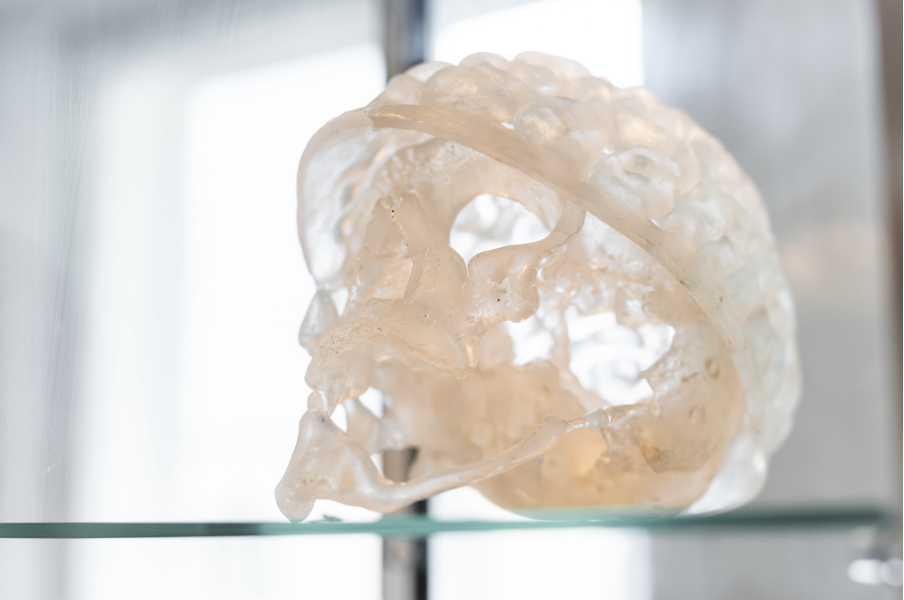
In extensively researching Hitler, I discovered how sexually perverse he was, very scatological, embarrassed by having only one testicle, etc. This evolved into an accompanying series, The Hitler Vitrines (2001; Fig. 16), where I appropriated Beuys’s use of vitrines as a museological construct, to deconstruct Hitler’s psychosexual profile.
SW: Wounded, shame-driven masculinity can be a dangerous combination! Not to mention that he was a failed artist, too.
You had family members who were killed in the camps, right? We talked before about how this was never spoken about in your family. It was a family repression. Had you already started looking into this? Or did you feel it as something that was almost in the DNA—like inherited trauma—that was coming up when you were in Germany?
“When I arrived in Emden, I presumed I would feel like an American Jew in mourning, but instead I was a guilty German Jew. My Germanness came forward so viscerally. I felt like a German Jew who never left rather than an American Jew whose relatives got killed or fled.”
MP: It was definitely inherited trauma. After I did Acheron, I applied for Holocaust memorials across the USA: Boston, Kansas City, Bayonne. I wasn’t happy with any of my ideas or concepts. After a decade of failed proposals (1986–96), I realized I had to go to the ‘Mothership’ and applied for a Fulbright in 1996 to go to Emden., Germany. Once again, I was working in decades.
When I arrived in Emden, I presumed I would feel like an American Jew in mourning, but instead I was a guilty German Jew. My Germanness came forward so viscerally. I felt like a German Jew who never left rather than an American Jew whose relatives got killed or fled. Therefore, I took responsibility for (and was ashamed of) my own demise! I combined my Jewish guilt with my German guilt. How fucked up is that? In retrospect, the process of masquerading as Hitler wasn’t as far-fetched as it seemed but an act of psychic absolution and, in an even weirder way, redemption. During my Fulbright, I had to go through the experience of reliving the Holocaust.
I forgot the name of the well-known historian who said, “When you start to investigate the Holocaust, it’s a black hole.” You keep digging yourself deeper and deeper looking for answers, but there are no answers. And you start to lose sight. When I first visited Emden in 1985, I immediately went to the Town Hall where the records were kept. I wanted to investigate my family. The woman at the desk looked at me. I always thought I looked Jewish, but I guess I didn’t to her. I said I was looking for records of my family’s history, and my name is Pels. She said, “Peltz?” (which is German for fur). Then I spelled it: P-E-L-S.
She smiled beatifically at me and went away to look for them. Maybe five minutes past and when she came back, she couldn’t look at me. She said, “Oh, Nein, Nein, Nein, you’re a Jew. You must leave. Your records would never be with ours. Never under the same roof!” I asked, Where might they be? But she shooed me away, still unable to look at me. This was 1985.
SW: What?
MP: Yes, this was 1985! There were a lot of anti-Semites in Emden. They were in the markets, drinking in the bars. Some of the old men stalked me.
SW: That’s terrifying. No wonder you were so afraid on the trains!
MP: When friends came to visit, they couldn’t believe it. We’d be sitting on a bus or a train and there’d be an old man across the way just staring at me with a death wish. Then, there were the little old ladies hunched over with their shopping bags and their eyes down coming towards me in the streets. These stooped over great-grandmas would look up and see me, stopping in their tracks and dropping their bags. I thought, What the heck is going on? When I went to East Berlin to visit a friend, the same thing kept happening, and I said to him, “Why is this always happening to me?” He answered “Don’t you get it? You’re the person they hid and saved or the one they gave up to the Gestapo.”
SW: This is an interesting context for your decision to put on Hitler’s uniform, to perform as Hitler, to allow his ghost to take you over.
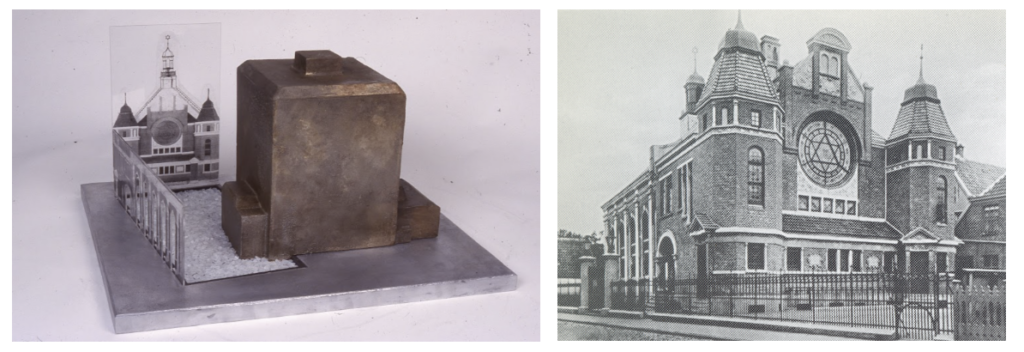
MP: It took me twelve years to go back to Emden again. And that’s when I got the idea to create a Holocaust memorial where both Jewish and German records were housed in the same location. The metaphor of the ghostly was important in my Emden Holocaust Memorial, Reclaimed Site; Bahnhofsbunker Projekt (1997–98; Figs. 17–18). It’s a monumental shimmering ghost of the Emden Synagogue transposed against a monolithic concrete air-raid bunker, the Bahnhofsbunker (or train station bunker). The front and left walls are photo-etched glass with the historical image of the synagogue being burned on Kristallnacht, the night of broken glass (November 8, 1938). The Bahnhofsbunker would become an International Research Center housing Emden’s Jewish and German records together. This had never historically been done in Emden or anywhere in Germany, for that matter. My sense of having a merged identity, German and Jewish, and the traumatic experience I mentioned earlier, inspired me to conceptualize this strategy.
SW: Okay, so we’ve talked about your relationship, your embodied and personal relationship to performance, which is quite different from the appropriation artists of the 1980s and 1990s.
Can we talk about language?
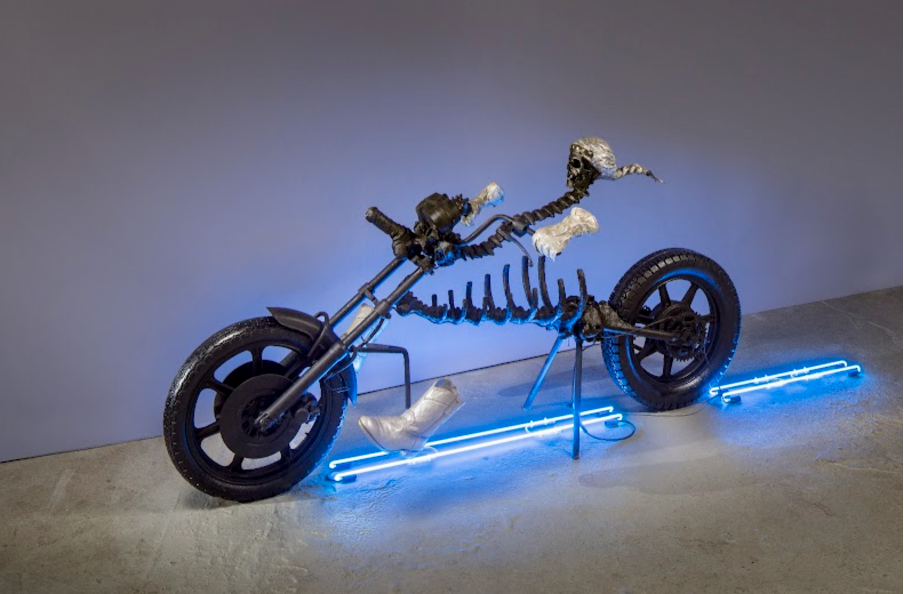
MP: Yes, but your question really made me think of my relationship to it in my work. I never thought of the argon-mercury signage in Dead Mother (2006; Fig. 19–21) and Dead Cowboy (2007; Fig. 22–23) as being about language.
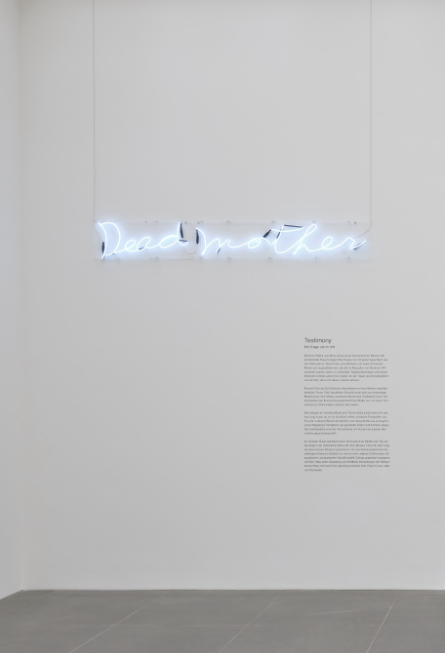
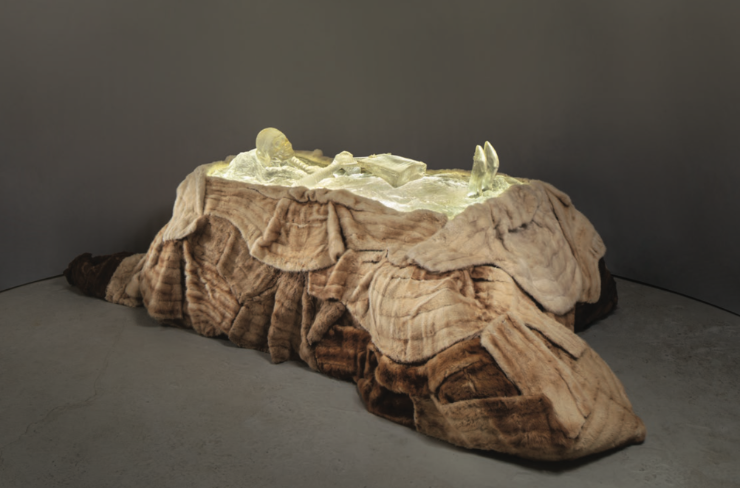
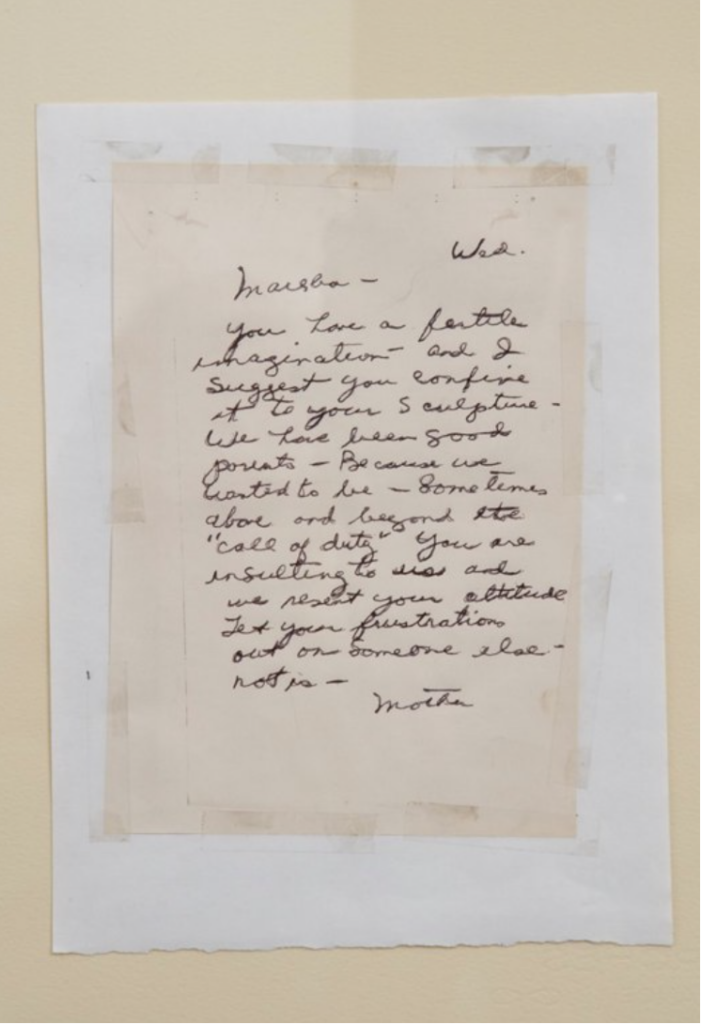
SW: I was thinking of the letter from your mother in the Dead Mother sculpture (see Fig. 21). It also ties into this issue of women’s violence towards other women, you know, the complexity and hostility that you were talking about with Louise [Bourgeois]. This, and the letter from your former partner, the Cowboy, in Dead Cowboy (2008; Fig. 22), are each part of a highly personal narrative, which is very different from a lot of conceptual art’s use of language. Although feminist artists like Mary Kelly [b. 1941] and Susan Hiller [1940–2019] used personal writing within a conceptual framework, your framework is very different.
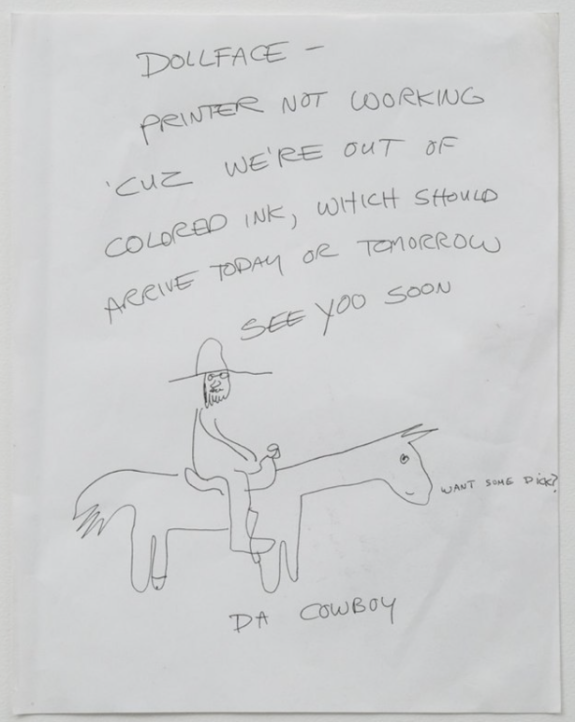
MP: It’s more emotional and humorous at the same time. As with the argon signs, I wasn’t thinking of language in the letters. They were simply fleshing out the memorials by expanding the narrative. My mother was nasty and accusatory; the Cowboy was an excellent cartoonist with a wonderful sense of humor. I use the handwriting in their letters to create the argon signs as the titles for the pieces.
SW: And this is after your mother died?
MP: Yes, from Alzheimer’s in 2005. The Cowboy rode out on his BMW ten months later.
SW: So, it’s a complicated work of mourning?
MP: Absolutely, for each of them. After my mother died, I was left with all her belongings. She was a fashionista of a certain generation. I was sifting through her mink coats and stoles, dozens of pairs of gloves, hats, handbags, shoes, etc. I put on each pair of gloves (also a performance of sorts?) and cast my arms in plaster. Then the Cowboy left, abandoning his gear. The tension between these two archetypal Freudian stereotypes—the bad mother and the bad husband—was palpable. To a certain extent, it was two halves of the same sculpture. There was a dialogue between them.
SW: So, we got to know each other last year through working on the show, Marsha Pels: CARNAGE (October 24–December 5, 2024) at the Art Gallery of the College of Staten Island. Although we have worked at the College of Staten Island together for fifteen years, we were on different schedules. We never intersected properly. I came by your studio last summer to talk about the idea of curating a solo show for the fall of 2024. It was going to coincide with the election.
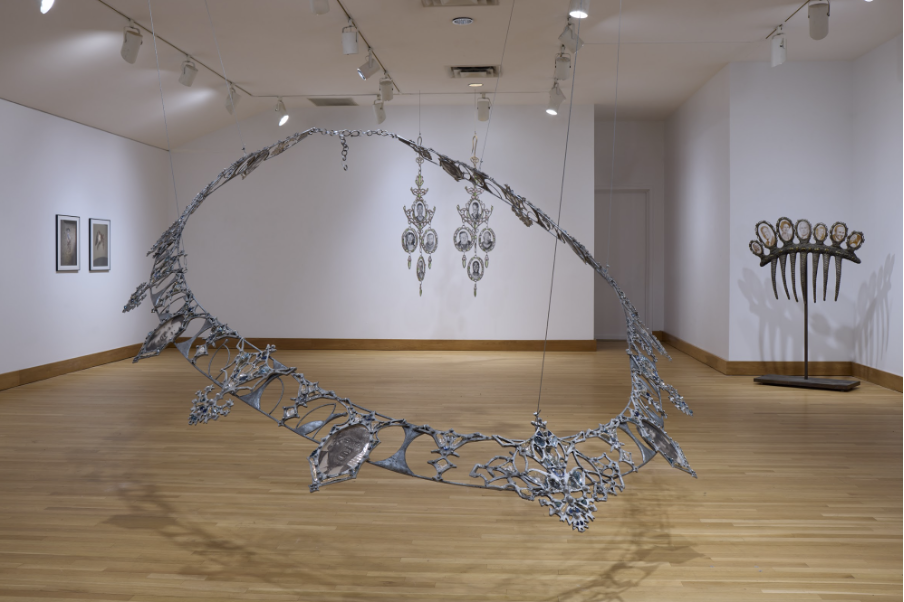
MP: We both agreed Fallout Necklace (2018; Fig. 24) from the series Trophies of Abuse (2013–20) would be perfect, and a thank you to my dear friend, Joan Semmel [b. 1932]. When Joan came for a studio visit, I was struggling to find a title for the sculpture. She immediately clinched it. I need to mention Joan for many reasons (Fig. 25). She is my real mentor, more so than Louise. What I know about feminism is because of our friendship. It wasn’t just her personal experience that enlightened me, but the history of the entire movement from the very beginning which she frequently spoke about.
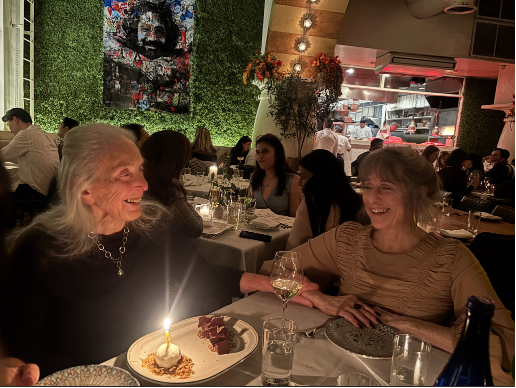
“She is my real mentor, more so than Louise. What I know about feminism is because of our friendship. It wasn’t just her personal experience that enlightened me, but the history of the entire movement from the very beginning which she frequently spoke about.”
Fallout Necklace is the largest in the series that began as a meditation on the gentrification of my Greenpoint, Brooklyn, neighborhood, from an industrial warehouse district on the abandoned waterfront into an alienating corridor of high-rise luxury condos. These buildings are so typically ugly that the area has no character and could be any city in America. It’s so unrecognizable and very sad. During the seven-year fabrication of these four sculptures, Trump became president (for the first time), and the narrative shifted darkly away from my little corner of the world to the wider global political situation.
As models for this over-scaled jewelry, I researched the European genre of cut steel and Berlin iron jewelry (1804–1918). Manufactured during the German industrial revolution, this jewelry became a symbol not only of patriotism and loyalty but a signifier of women who sacrificed for the “Fatherland.” Twice in Germany’s wartime history, aristocratic German women were ‘urged’ to give their jewels to the war effort in exchange for a less expensive form of adornment. Iron and steel were not gold and diamonds.
The creation and transfer of wealth through feminine artifacts to solidify and abuse power for nationalistic purposes coalesced with the transformation of the urban landscape, from a proletarian homestead to a playground for the wealthy. It seemed an appropriate metaphor for the ever-changing value of cultural currency. Fallout Necklace highlights eight photo-etched glass cameos of dominant world leaders representing the global superstructure. Each one is responsible for either saving or destroying civilization and the planet (Fig. 26).
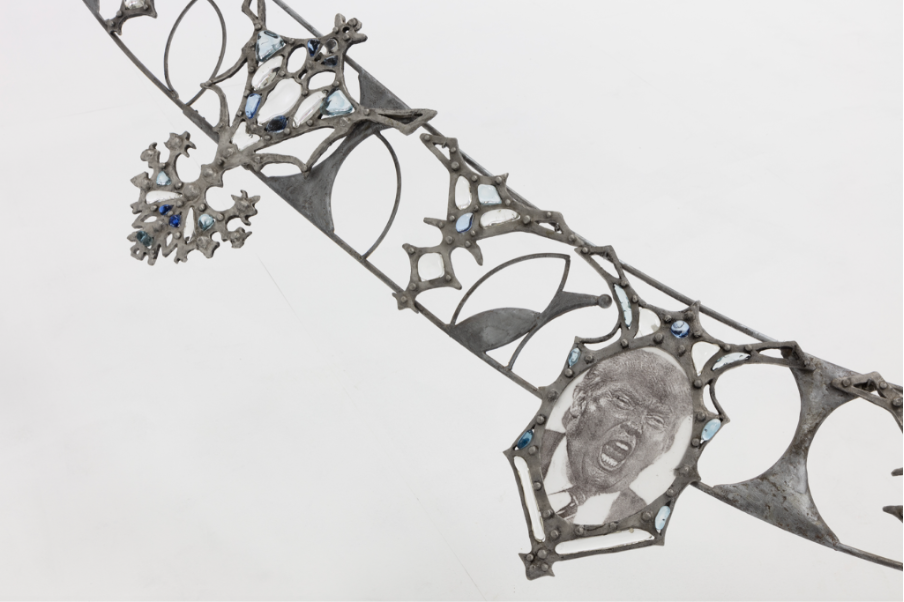
SW: It intuitively seemed to work for the context of Staten Island and for the nastiness that was surely going to be part of the election campaign. Then you showed me the series of photographs, Retribution (2022), that you had never exhibited before. The images show dead, disemboweled rats (Fig. 27), and in one case a dead and mutilated (partially eaten) pigeon. They were taken with an iPhone, so when enlarged they have this visual fug to the surface, that looks a bit like a painting.
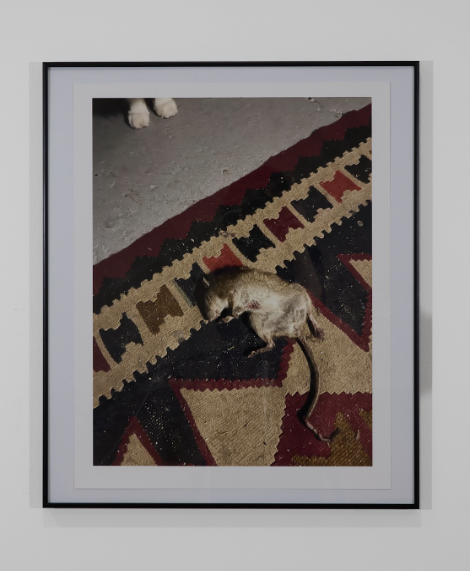
MP: Retribution is a memorial for my beloved, little striped huntress, Jackie O. Whenever I returned from traveling, she’d leave me strategically placed ‘gifts’ of dead vermin, as cats do as welcoming signs of affection. Within a few days of my leaving for Italy in the summer of 2023, my partner called me in Todi very upset, because a few days had gone by and he couldn’t find her. She was a smart, adventurous cat and had left for days before, always to return home safely.
But that week, there had been an extensive fire in Canada, and New York was covered in black smoke. It was one hundred and ten degrees. Finally, after three days, he heard a faint sound from underneath our loft to find her locked in a storage room unable to escape. The vet said even without food, water, or her daily asthma pills, she might have survived, but she had bitten into a poisoned rat and died a horrible death. The rats got her back.
SW: The photographs were in dialogue with these colossal scale sculptures that indexed and imaged local and global political power, gentrification, and the sexual abuse of children with the scratched-out faces of local pedophiles in a halfway house here in Greenpoint, where you live.
MP: Yes, this was another side effect of gentrification.
SW: I think we both intuitively thought it would be an allegorical response to the Trump/ Harris election and the gender tensions that were building. We trusted that it would speak to what would play out, without really knowing how. It was a leap of faith. So, the show opened a week before the election. And then we had a panel discussion after the election. Can you talk about the feeling of “suspension” that we went through? How did this change your relationship to the sculptural series?
MP: I was anxious about how that audience would respond under the circumstances. But I never think about anyone when I’m making my work. All an artist really wants, other than to be able to do the work, is to hope that people will understand it. But I never think about that. My work creates strong polarities in viewers. It’s either hated or loved. I don’t mind which response it is, only if someone has a strong emotional reaction.
I was worried people would try to damage the necklace and the photos. The Hitler photograph was just shown at The Neues Museum in Nuremberg (of all places) [Testimony: Boris Lurie and Jewish Artists from New York, September 26, 2025–January 2, 2026], and I was concerned about it being destroyed. We are living in treacherous times for works such as my more political pieces.
SW: Right. And I was also thinking about the danger of the work being vandalized (although this has never happened).
MP: And the photographs are disturbing. They’re beautiful in an odd way, yet people found them too ugly to look at. But it didn’t change my relationship to the series. As soon as the work leaves the studio, it’s over and out there in the world. My relationship to it doesn’t change.
SW: Don’t you think about it differently if you see it resonating in the world in ways that you didn’t predict?
MP: Perhaps. These two series had never been shown altogether, so the relationship between them was exciting. But did it change my relationship with them? No. Something that amazes me is, I’ll make something quite a while ago, and when it’s shown, decades later, it’s still prescient, sometimes even more so. As time passes, the work gathers different meanings as a reflection of the times, even though it was made in and for a very specific time. The horror of war is a major theme of mine, does this go in cycles or is there always a war? The Zeitgeist never stops.
SW: But you are open to other people having a different interpretation of the work?
MP: Of course. In fact, the more multiple layers of meaning there are, the better.
SW: With CARNAGE, the relationship between the dead rats, the beautiful sculptures with the politicians, and the pedophiles, it said something about the election cycle that, of course, you could not have thought of.
MP: Yes, I only realized that from your insightful essay for the catalogue.3 There were connections I didn’t realize. An artist comments on what is happening, what they see around them or remember, they’re not predicting what might happen in the future, even if they presume to do so. Maybe some of the Trumpers seeing the show did think of something in a different way. Maybe. I don’t know; you can’t really know. And if they did, I doubt it lasted long.
SW: But I think it held a space for the students who are not Trumpers.
MP: Yes, I agree, a clarification of sorts. And perhaps the non-committal or indifferent students, too. But I don’t consider myself the kind of political artist who sets out to polemicize.
SW: Let’s talk about the panel discussion we held in the gallery a week after the election. Because of the way that the work was installed, you could enter the necklace, walk underneath it, and so we laid out the seats so people could sit underneath it (Fig. 28).
MP: Excellent staging.
SW: It was imposing to have this thing suspended above you, and you could see it on the faces of some of the students. That they were kind of awkward or vulnerable. We both felt very anxious about the presentation, because of this understanding that we might live in a bubble, but we don’t work in a bubble. We can see into this other bubble, and we must engage with it. There was something very powerful about our collective proximity to this work that was both delicately beautiful and menacing. What was important to you about this event?
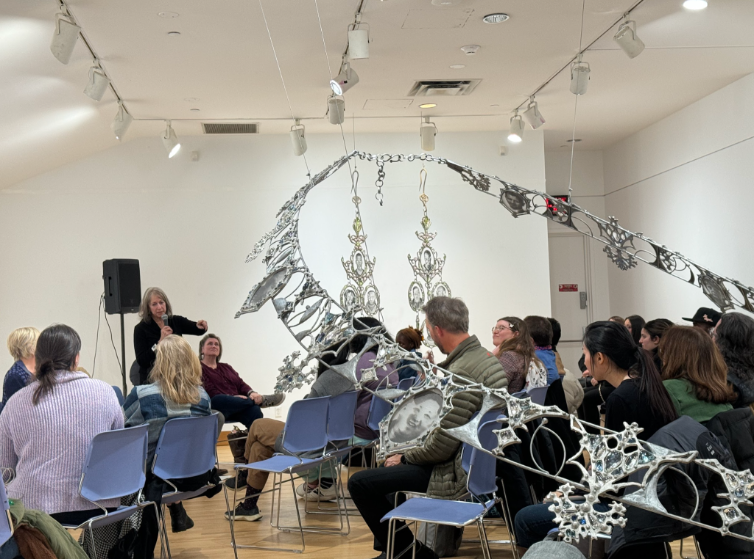
MP: It was rewarding to hear so many intelligent and varied perspectives of what the work meant to the panelists. You certainly chose the perfect panel.4 My work is so difficult; it can repel people, so I feel I must seduce them so they can enter the space or the sphere of the object. It was very important the audience was a part of the sculpture, not distanced from it. I don’t even mind if people touched it. It’s the best way to experience sculpture.
SW: We had a lot of different students in the room as well: we had a political science class, a media culture class. We had an expert on the panel who’s been working on the Manosphere. He’d written a book on Fox News, Reece Peck. He gave a really spot-on analysis of the way in which the far-right has co-opted masculinity, making it kind of impossible for all these men to vote for a woman, right? And he spoke personally about his relationship to masculinity, coming from a working-class family, and raising boys.
We had the director of the Women’s Center [Bertha Harris Women’s Center, College of Staten Island, City University of New York], Catherine Lavender, who talked about wearing men’s clothes after the election as an act of solidarity with the trans community; she’s a heterosexual woman. This was also like a beautiful idea of embodying her politics, embodying a reaction that you can’t necessarily articulate directly. You talked about the materials, the process. And then we had the artist Kat Chamberlin [b. 1981], who knows your work well, she’s currently your assistant, but is also a sculptor in her own right. I have curated Kat’s sculpture in another curatorial project.5 She talked about her research in hostile chatrooms on the dark web.
So, anyway, we had a lot going on and what happened for me was that there was a kind of interesting way in which the academic mode was interrupted by these personal responses from you, Kat, and Catherine. Then I felt the energy of the room shifted from contempt and sneering ridicule, from tense opposition to one of engagement.
MP: It was evident; it started slowly, but suddenly, I looked to see them attentive.
SW: I’ve said this to you before: it was the best panel discussion we’ve had, because I think we talked about the work; we talked about how it interacts with these other things going on in the world; and it was real and personal. We were also talking about feeling kind of horrified and in mourning that people would vote for such an obviously immoral and contemptuous person.
Trophies of Abuse was earlier (2013–20), coinciding with Trump’s first election. But it worked for the 2024 context. Since you made that work, you’ve done other work that has been engaged with the political climate, for instance, The Madonnas (2020–23).
MP: After I finished Trophies of Abuse, I was concerned I was in the same trap that I periodically get stuck in, by depending on metal casting. I wanted the next series to be much freer in my material choices with not much casting involved. The Madonnas were the most exciting series I’ve recently worked on. I didn’t have distinct concepts to begin with (as I usually do, and don’t veer away from). I was responding to current political events. First was January 6th and the image of the noose for Mike Pence. Then the war in Ukraine, which recalled torture photographs of the Abu Ghraib prisoner abuse in 2004, then the overturning of Roe v. Wade (in 2022). Everyday I’d wake up and something else horrific was happening. Finally, it’s as if I got sick from it all, and life got in the way. I had to have a series of operations.
I was amassing found objects that kept evolving conceptually. They were either given to me or bought or found in the street. I kept mixing the objects up and assembling them in very dissimilar ways. It was incredibly fluid. I’d be working on all four at the same time, disassembling them, recontextualizing them into completely new structures, and then start over again! The collection of found objects miraculously kept growing as I fabricated the sculptures (Fig. 29).
Though there are four sculptures in the series, I’d like to discuss only two. Madonna di Misericordia (2020–23; Fig. 30) is named after my favorite Piero della Francesca painting, Madonna della Misericordia (1460–62) in the Museo Civico di Sansepolcro in Tuscany. This translates as “mercy” or “compassion.” I started this sculpture after Roe v. Wade was overturned. I wanted to show how this reversal would deeply trap and injure women.
The sculpture went through many transformations, but it began with a nineteenth-century antique wedding petticoat that Joan’s [Semmel] daughter, Patti, gave me the previous Thanksgiving. When I hung it high in the studio on a rusty chain hoist (that I’d been saving for years!), I then remembered standing in sculptor Isaac Witkin’s foundry in New Jersey, on a blueberry farm amongst piles of crap everywhere. He’s shaking his finger and telling me, “But Marsha, NEVER throw anything out. You never know when you’re going to use it.” He was, of course, right!
I soon envisioned the white shape of the petticoat as the flayed blue cloak of the Madonna. In the painting, the Madonna is shielding the people with her cloak. I decided little girls should be protected under the petticoat. That Christmas, I came across the perfect dolls for the sculpture at my favorite neighborhood 99 cent store right down the street. I previously had dozens of Barbies hanging under it. My Barbies were white, so my friends urged me to buy a politically correct mélange of Black, brown, and Asian Barbies. But the Barbies were a loaded signifier that was taking the piece in the wrong direction.
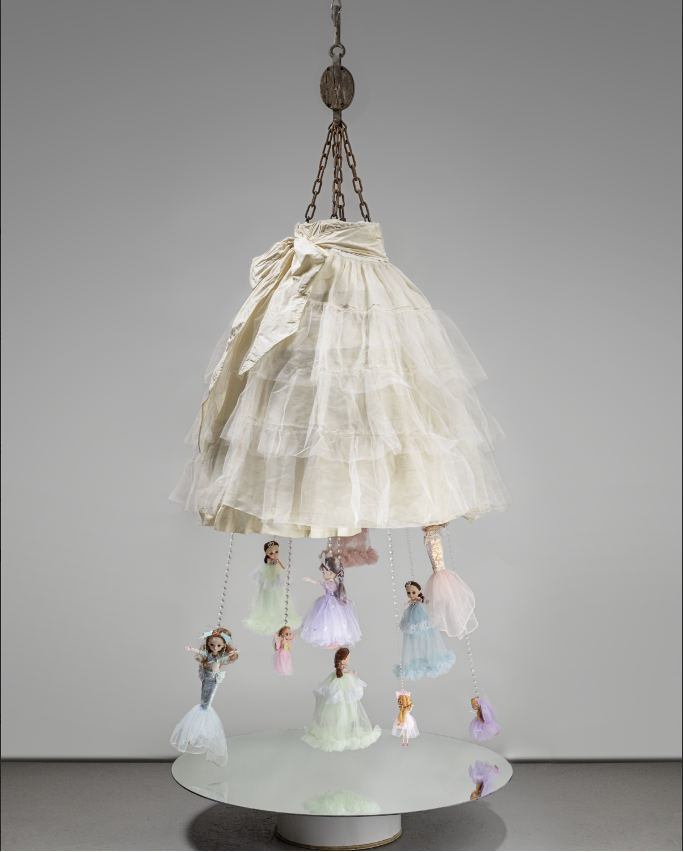
These new dolls were perfect in every way. The largest one had a red plastic heart on her chest. When you pushed it, it played the Frozen theme song, “Let It Go,” sung by Idina Menzel. The Elsa doll had previously been the inspiration for a series of sculptures I had done eight years earlier. It was karma to use her again. This discovery inspired an audiotape of a condensed version of the song with the voices of my friend’s wife and their two daughters (aged seven and sixteen). I wanted three generations of women.
They are a loving, close-knit family, so they sounded amazingly beautiful as a melodious Gregorian chant. It looped repetitively as it crescendoed from a scream to a whisper. The volume of the song coordinated with the speed of the dolls as they spun above a raised glass circle spinning in the opposite direction. I thought, You’re a little girl. You dream of marrying a prince. Then you’re fucked. You’re spinning around in circles, but you are trapped, unable to go anywhere.
While working on the Madonnas I kind of fell apart. My right hand was swollen and misshaped from decades of abuse in the studio. I was in tremendous pain and couldn’t work. (I remember what Louise’s [Bourgeois] hands looked like in her old age). I had to have an operation on my right hand. Soon after, I had a hip replacement and, most recently, I had spine surgery. This was the impetus for Madonna il Invecchiamento (2020–23; Fig. 31), which translates as “aging,” becoming “old,” or “worn out.” I assembled the hospital equipment I had acquired in the loft: a wheelchair and a porta-potty, which was later covered in deer hide. I dreamt of deconstructing these symbols—of being an invalid and welding them together to create a new dual-functioning contraption. My friends convinced me to cast my hands before I had the operation, which I did in aluminum. Before my hip replacement, I also cast a pink glass coccyx. This surreal hybrid was an apparatus that also became an anthropomorphic body. When you’re sick, you realize how much your body is a machine that isn’t functioning properly.
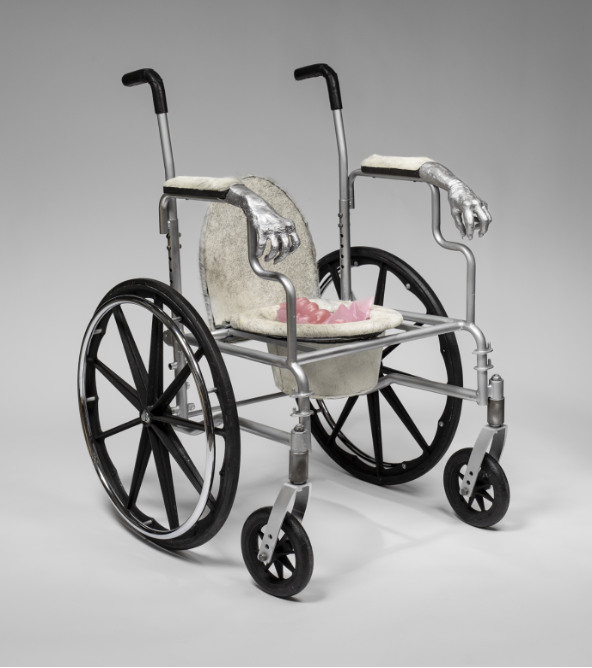
cast aluminum, leather and deer hide. Photo: Nicholas Knight.
SW: Perhaps we should close by talking about what you’re working on right now.
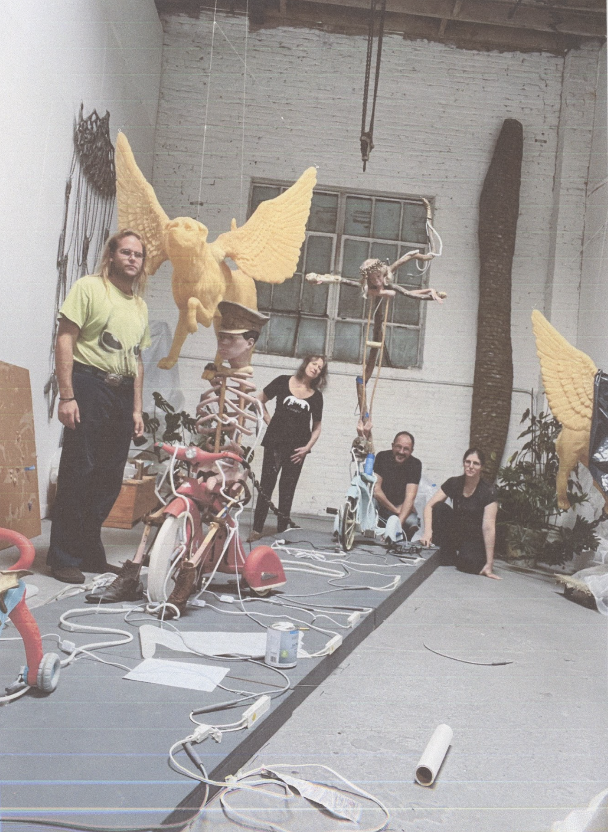
MP: I’m almost finished with a very large sculpture I’ve been working on for over two years, The Brazen Serpent (2023-25; Figs. 33–35). It’s been a helluva challenge technically, and I’ve had many adroit fabricators involved in this process (see Fig. 32).
I’ve been using Barbie dolls in my work since the mid-nineties, not just the discarded tri-color Barbies from the recent Madonna sculpture, but years before as a talisman representing an implicit indoctrination device for young girls. You don’t play with a fat, dumpy doll. Barbie remains a potent symbol of femininity, no matter how twisted she is.
I love driving along the Autostrada in Italy and for two summers, from 2023 to 2024, I’ve had the pleasure to do so. They have these fabulous rest stops without a McDonald’s or a Starbucks, but instead magnificent spreads of cheese, charcuterie, and made-to-order pastas with shelves of chocolate and the regional wines behind the counters.
They also sell all kinds of products. Maybe because of the recent Barbie movie (which I saw in Italian, in Todi, on the roof of a church below a full moon), they were selling, what I would call, for lack of a better explanation, ‘Italian’ Barbies. These dolls were more sophisticated with different faces, but similar features and expressions. Some were almost life size but cut below the shoulders to include the arms. I was fascinated by them and dragged one home, cutting it up to fit into my suitcase. I had no idea what I would do with it. But I soon found an old tricycle at my favorite Staten Island flea market. Then, in my truck, I schlepped home some washed up, elegantly shaped tree branches from a Connecticut beach. And voila!, the sculpture began to come together.
“Since Trump was elected again, I keep having apocalyptic nightmares. I’m not certain how this relates, but I needed to crucify Barbie. It seemed a fitting motif.”
Since Trump was elected again, I keep having apocalyptic nightmares. I’m not certain how this relates, but I needed to crucify Barbie. It seemed a fitting motif. After I crucified her on the tricycle with a bronze crown of thorns, friends of mine found me a newer tricycle in a Pittsburgh antique store, so I started to conjure Ken (Fig. 34). He needed his own crown, so I cast the bronze Hitler hat from the uniform I wore in the photograph. Barbie and Ken conceived a child of indeterminate sexual orientation. During the fabrication of this piece, I had that spine surgery, so I cast a bronze rib cage with a prominent spine for their offspring (see Fig. 33).
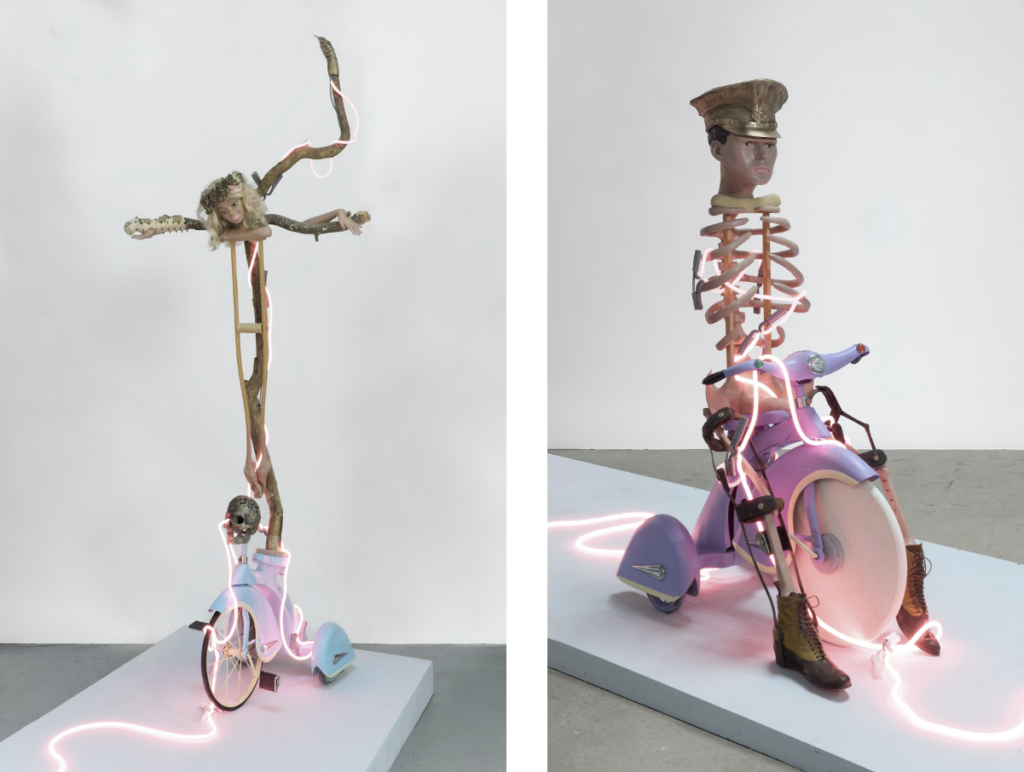
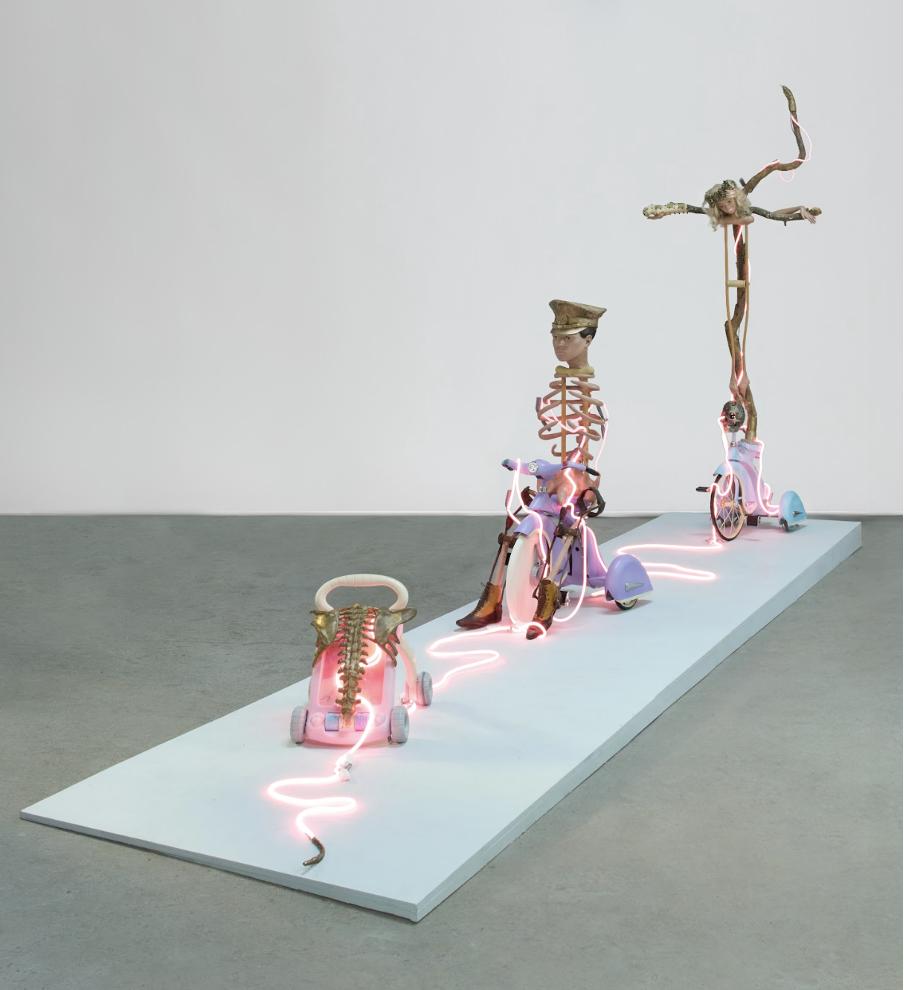
From the beginning of the conceptualization of this sculpture, I was thinking in biblical terms, not just of the representation of Jesus, but also of Adam and Eve, with Barbie and Ken as their post-modern alter egos. While doing research to find famous paintings of the crucifixion throughout the ages (Michelangelo’s frescos, among others), the serpent miraculously appears. There he is entangling bodies with venomous energy in the lower right-hand side of the paintings and snaking through the image twisting upwards on a pole in the distance. My serpent is seventy-four feet of hot pink argon-mercury with a bronze head and tail. It slithers down the pole through the sculpture interconnecting my nuclear family.
The actual story of the “Brazen Serpent” is from a significant biblical passage in which God advises Moses to make a brass serpent on a T-shaped pole as a curative device to end the plague of snakes. I first discovered these ancient images of Nehushtan, from circa five hundred fifty BCE. Medieval art juxtaposed the subject with the serpent in the Garden of Eden by entwining the Tree of Knowledge. A modern version of this is The Christological Symbol on Mt. Nepo in Jordan, by the Italian sculptor Giovanni Fantoni from the 1930s. Both probably derive from an ancient and widespread fertility image representing, respectively, the male and female elements. The symbol remains an invitation to ponder the recurrent human concern for bodily and spiritual healing, which is why it is associated with the medical profession. As I worked on this for over two years, and the political scenario kept shifting, I only then began to understand what drama it was playing out. Open to interpretation, as ever (Fig. 36).
- Mira Schor, “Generation 2.5,” A Decade of Negative Thinking: Essays on Art, Politics, and Daily Life (Duke University Press, 2010), 51.[↩]
- Mira Schor, “Blurring Richter,” A Decade of Negative Thinking: Essays on Art, Politics, and Daily Life (Duke University Press, 2010), 177.[↩]
- Siona Wilson, “It’s Always the Year of the Rat,” in Marsha Pels: Carnage (The Art Gallery of the College of Staten Island, 2024): 5–12.[↩]
- “Art / Gender / Politics: A Post-Election Conversation” (November 13, 2024) with Kat Chamberlin, Catherine Lavender, Reece Peck, Marsha Pels, and Siona Wilson.[↩]
- Siona Wilson, Girls + Eggs: Contemporary Art Against Reproductive Injustice (Duke Hall Gallery of Fine Art and University of Virginia Press, 2025).[↩]