 Written by
 Institutional subscribers can access this issue at the Old City Publishing website. The issue is available for purchase in print and digital (PDF) format. To subscribe to WAJ, click here.
Featured image on the WAJ homepage: Firelei Báez, Ciguapa Habilis (After Carl Linnaeus) (2010), gouache, watercolor, and ink on paper, 72” x 102”. © Firelei Báez. Courtesy the artist and Hauser & Wirth.
WAJ’s Spring/Summer issue interrogates systems of knowledge that inform our ways of organizing societies, collections, and visual theories. The articles foreground strategies whereby artists transgress geographical and governed identities, or recast time-bound models of cultural and scientific inheritances. In their embrace of the polytemporal, formless, and unconstrained, the artists presented here disrupt, reject, and counter Western modalities of social order often derived from institutional, racial, and misogynistic forms of classifications and taxonomies.
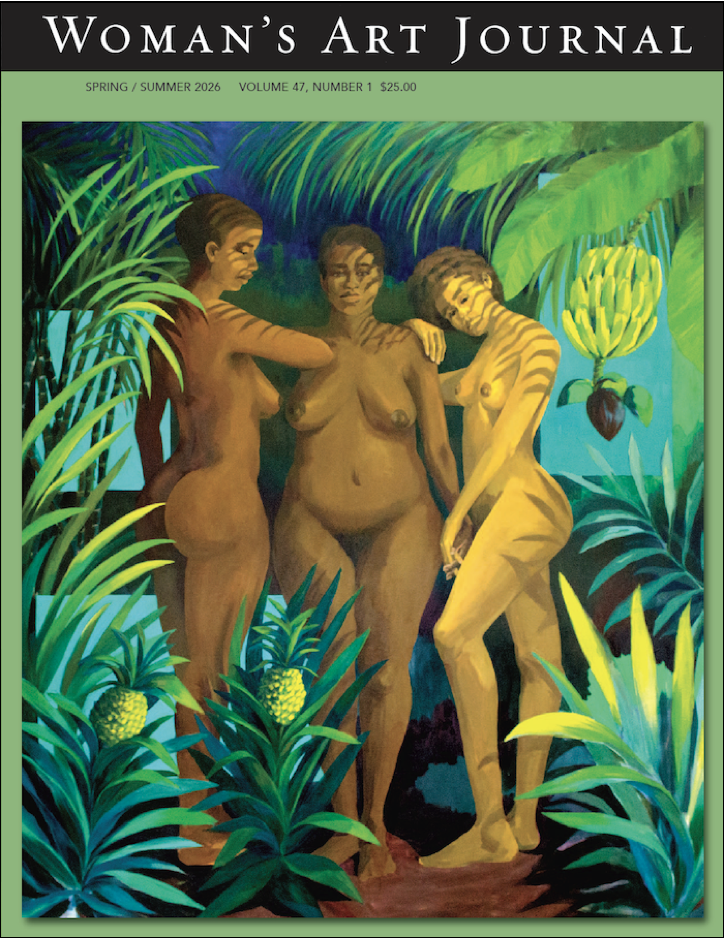
The “tropical aesthetics” of Firelei Báez and Adrienne Elise Tarver are rooted in the exploitative “ecologies of racism” following the devastating effects of colonialism and slavery in the Caribbean and Southern US. Their “utopic” relations to worldmaking, argues Samantha A. Noël, propose freedoms beyond place and selfhood through Black speculative agency. Báez’s folkloric ciguapa are “unclassifiable” and “unquantifiable” bodily and plant specimens measured against the legacies of taxonomy. Tarver’s sub-tropical landscapes subsist outside the bounds of time, the viewer imbricated within the cultivated gaze of her unflinching Black female subjects. Encountering our cover’s Three Graces, Tarver transfigures an historical yet dehumanizing ethnographic photograph into a monumental painting of uppermost Black self-possession.
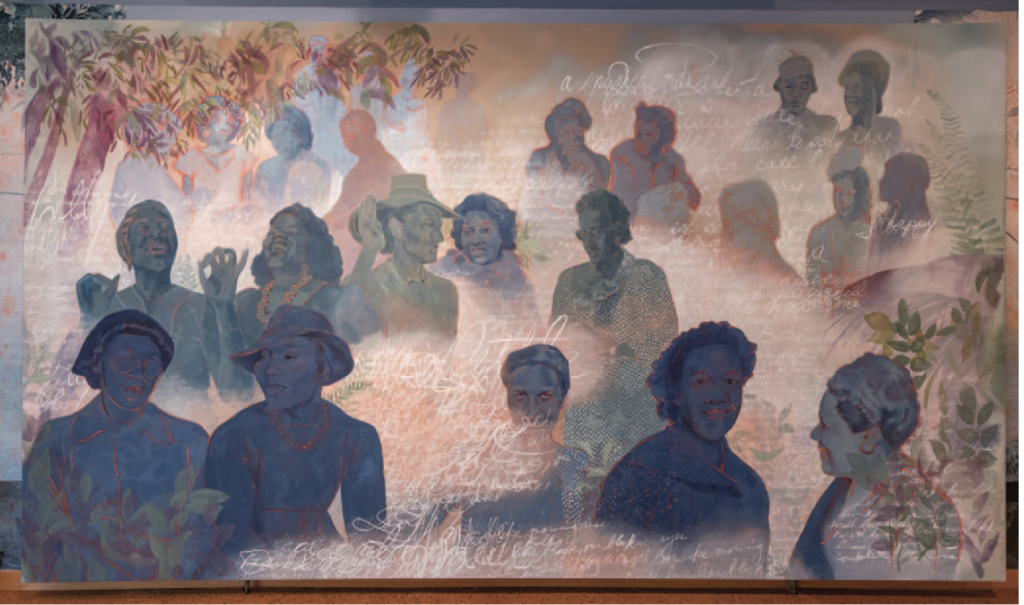
Firelei Báez, Elegant gathering in a secluded garden (or the many bridges we crossed) (2018), acrylic on canvas, 108″ x 192″. The Studio Museum in Harlem; Museum purchase with funds provided by the Acquisition Committee 2018.28.
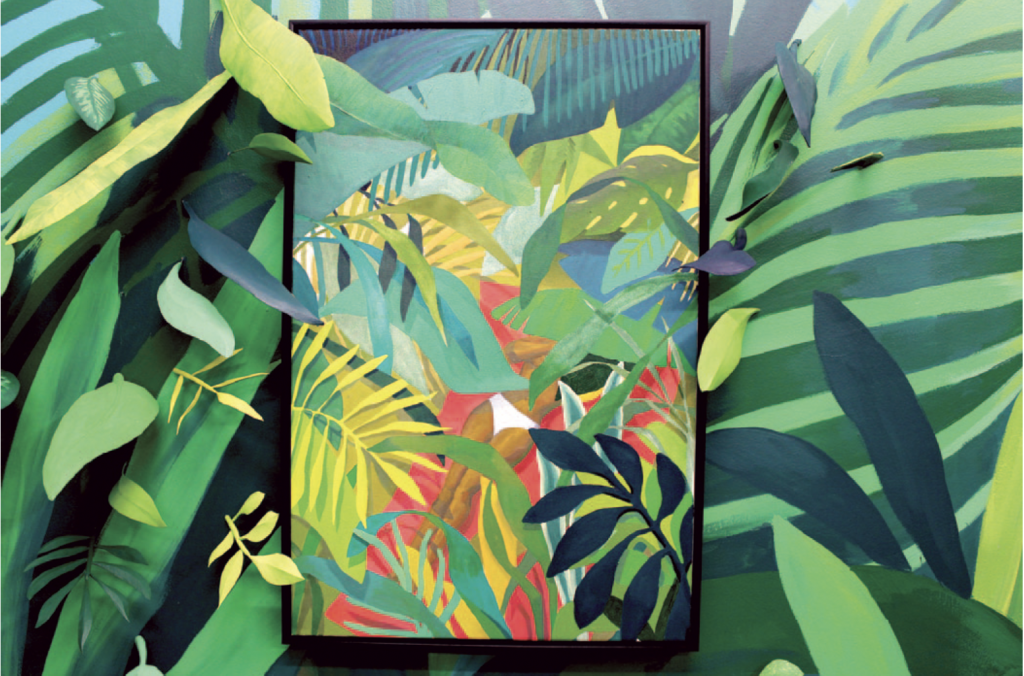
Adrienne Elise Tarver, Secrets of Leaves (2017), oil on canvas, 36” x 24 1/2”. Courtesy of the artist.
Jennifer S. Griffiths chronicles Artemisia Gentileschi’s afterlives in American art through models of “feminist time,” kinship, and fandom. Drawing on the transhistorical thinking of Mary Garrard, Griffiths traces Artemisia’s images as “floating feminist signifiers” and centrifugal forces of feminist consciousness that disrupt our linear reading of art history in favor of cyclical “waves and echoes,” loops, or “women’s time.” Debates from the seventies surrounding The Sister Chapel and the Cooperativa Beato Angelico are discussed alongside more recent artist projects by Kathleen Gilje, Anna Ostoya, Betty Tompkins, and Lili Bernard. For Griffiths, Bernard’s symbolic appropriation of Artemisia activates Afrofuturist “counter-histories that reweave connections between past, present, and future,” concepts arising in Elizabeth Carmel Hamilton’s Charting the Afrofuturist Imaginary in African American Art, reviewed in this issue.
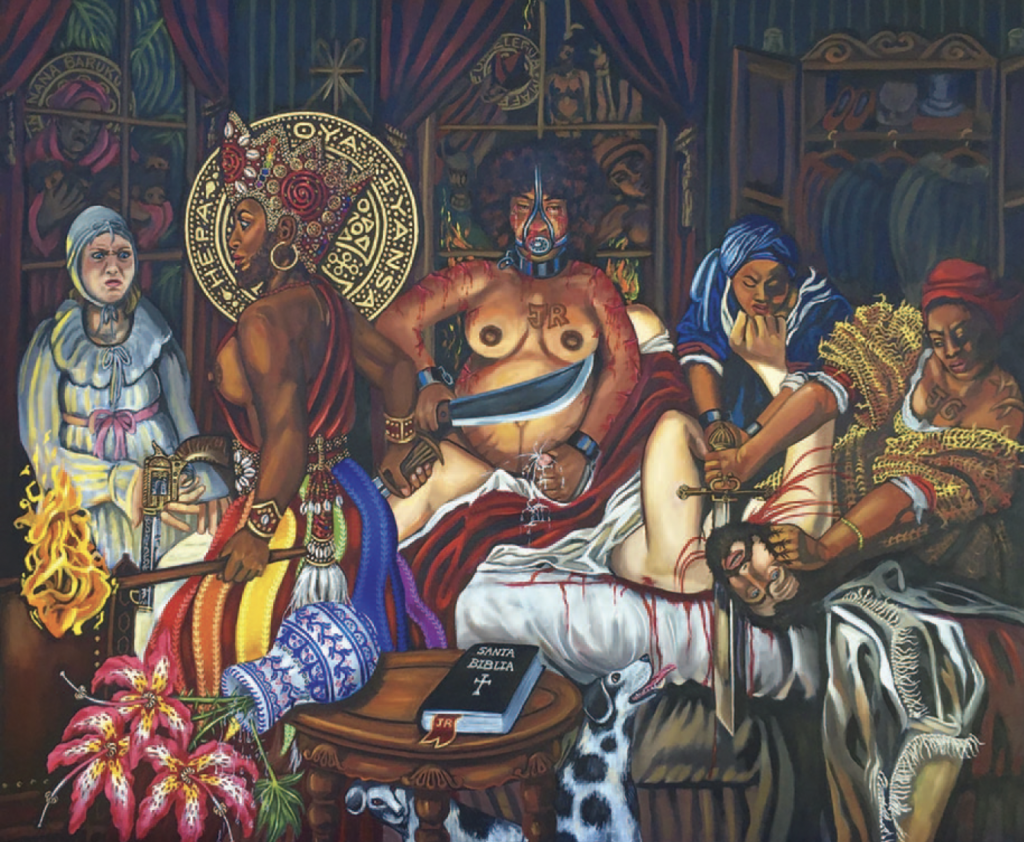
Lili Bernard, Carlota Slaying the Slaver (after Artemsia Gentileschi’s Judith Slaying Holofernes, 1612) (2015), oil on canvas. 72” x 96”. Collection of the Artist. © 2026 by L I L I B E R N A R D.
Allison K. Young examines an understudied photographic body of works by Zarina Bhimji from the nineties that probe our complex subjective and bodily relationships to Western medicine and science and challenge the “classificatory modes” underpinning such institutional spaces and disciplines. Plumbing the pathologies of the “clinical gaze,” Bhimji’s carefully curated light boxes and vitrines of chemically preserved organic and human matter ultimately resist our desires for objectivity and compartmentalization and “liberate” her subjects intuitively, corporeally, and erotically.
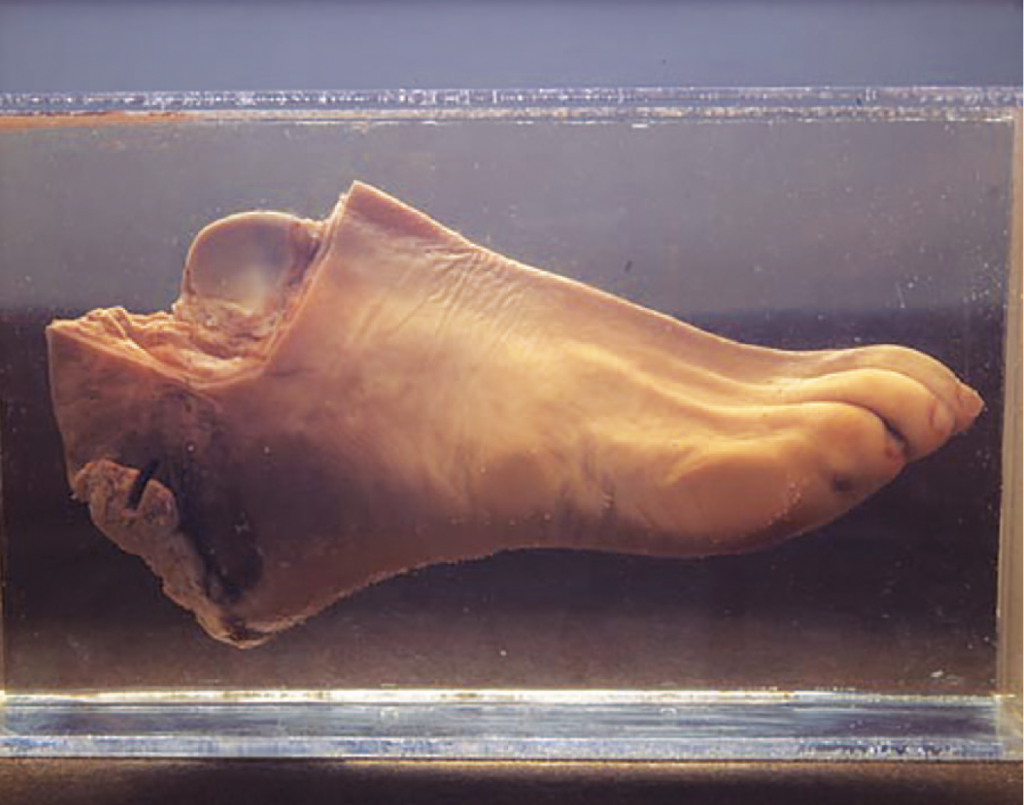
Zarina Bhimji, Indelible from the series Listen to the Room (1995), one of eight Cibachrome photographs mounted on lightbox. Collection Charing Cross Hospital, London. © 2025 Zarina Bhimji / Artists Rights Society (ARS), New York / DACS, London.
The seventeen book reviews orchestrated by Melissa Mednicov and Erin Devine beckon today’s lot of prodigious feminist publications. Tori Champion contextualizes the rich stories and political heft behind the strategic art patronage and commissions of Catherine the Great, who enlisted from her orbit such prestigious women artists as Élisabeth Louise Vigée Le Brun and Angelica Kauffman and amateur female members from the royal household. Oana Stan fields the “symphony of interpretations” in the first interdisciplinary study on the early Dutch modernist Rachel Ruysch, whose famed flower still lifes bridged botanical science, conservation, and experimental botany. In her extensive coverage of three monographs on Italian early modern women artists—Sofonisba Anguissola, Elisabetta Sirani, and Artemisia Gentileschi—Margaret M. Barnes skillfully reconstructs the fabric of their artistic, business, and social livelihoods in their native cities. Britta Dwyer channels the brilliant transatlantic activities of sixty expatriate modern women in avant-garde Paris, some as famous as master networker Gertrude Stein, others less known, such as the costume designer Winnifred de Wolfe, queer author Djuana Barnes, and Black sculptor Nancy Elizabeth Prophet. In Great Britain at the turn of the nineteenth century, Nancy E. Green marks the advancements and struggles for women’s rights, particularly in marriage and property laws, a period that eventually saw the opening to women of royal academies, exhibition spaces, guilds, societies, and clubs.
In a joint review by Kalas Ke, the sexually explicit photomontages of Anita Steckel, a virtuoso of humor, female pleasure, and freedom of expression, is presented alongside the erotic representations of Joan Semmel, Betty Tompkins, and Tee Corinne. Shannon Bewley identifies MoMA’s women, the fourteen underrecognized and often uncredited female founders (donors, curators, collection managers, archivists, publicists, conservators) of the lauded twentieth-century art institution. Anna E. Dobbins unveils the illustrious figure of Gertrude Abercrombie whose salon and “bop” paintings took center stage amongst the music and art scene in Chicago. Elizabeth Carmel Hamilton’s review determines how art refuses to serve as reparations for Black women in racist and patriarchal society, calling for “reproduction without futurity” and releasing expectations of positivity in favor of revulsion and disgust. Hamilton’s own expansive critical framework of Afrofuturist aesthetics and the Black Female Fantastic is featured by Sarah Richter. The artistic trajectory of photographer Gail Rebhan, intimately focused on self-portraiture and the lived experiences of motherhood, reflecting a “beginning and ending with the self,” is captured by Sally Jane Brown. Two decades of Diana Al-Hadid’s sculptural production is analyzed by Şeyma Müge Iba with an emphasis on the unresolvable and impermanent strategies of “becoming and unbecoming” that scaffold the artist’s conceptual, material, and ritual experimentation. Roja Najafi maps the abstract entanglements and kinetic geometries throughout the six-decade career of Palestinian artist Samia Halaby. Women’s contributions to the creative and racial diversity of the French and Belgian bande dessinée is sketched by Natalie J. Swain.
Joan Marter and Aliza Rachel Edelman
Editors, Woman’s Art Journal
Parallel Perspectives
p. 2
By Joan Marter and Aliza Rachel Edelman
Portraits, Issues and Insights
p. 3
Utopic Tropical Imaginings: The Black Speculative Undercurrents in the Art of Firelei Báez and Adrienne Elise Tarver
Samantha A. Noël
p. 15
Artemisian Afterlives in American Feminist Art
Jennifer S. Griffiths
p. 27
“Categories Always Leak”: Zarina Bhimji’s Institutional Critique
Allison K. Young
Reviews
p. 38
Women Artists in the Reign of Catherine the Great
By Rosalind P. Blakesley
Reviewed by Tori Champion
p. 40
Rachel Ruysch: Nature into Art
Edited by Robert Schindler, Bernd Ebert, and Anna C. Knaap
Reviewed by Oana Stan
p. 43
Sofonisba Anguissola
By Cecilia Gamberini
Elisabetta Sirani
By Adelina Modesti
Artemisia Gentileschi and the Business of Art
By Christopher R. Marshall
Reviewed by Margaret M. Barnes
p. 46
Brilliant Exiles: American Women in Paris, 1900–1939
By Robyn Asleson with contributions by Zakiya R. Adair, Denean Sharpley-Whiting, Samuel N. Dorf, and Tirza True Latimer
Reviewed by Britta Dwyer
p. 49
A Room of Her Own: Women Artist-Activists in Britain, 1875–1945
Edited by Alexis Goodwin
Reviewed by Nancy E. Green
p. 51
Anita Steckel: The Feminist Art of Sexual Politics
Edited by Richard Meyer and Rachel Middleman
Sexually Explicit Art, Feminist Theory, and Gender in the 1970s
By Christian Liclair
Reviewed by Kalas Ke
p. 54
Inventing the Modern: Untold Stories of the Women Who Shaped the Museum of Modern Art
Edited by Ann Temkin and Romy Silver-Kohn
Reviewed by Shannon Bewley
p. 56
Gertrude Abercrombie: The Whole World is a Mystery
Edited by Eric Crosby and Sarah Humphreville
Reviewed by Anna E. Dobbins
p. 57
Undesirability and Her Sisters: Black Women’s Visual Work and the Ethics of Representation
By Tiffany E. Barber
Reviewed by Elizabeth Carmel Hamilton
p. 60
Charting the Afrofuturist Imaginary in African American Art: The Black Female Fantastic
By Elizabeth Carmel Hamilton
Reviewed by Sarah Richter
p. 62
Gail Rebhan: About Time
By Sally Stein
Reviewed by Sally Jane Brown
p. 65
Diana Al-Hadid: unbecoming
Edited by Rachel Winter and Molly Taylor
Reviewed by Şeyma Müge Iba
p. 67
Samia Halaby: Centers of Energy
Edited by Elliot Josephine Leila Reichert and Rachel Winter
Reviewed by Roja Najafi
p. 70
Drawing (in) the Feminine: Bande Dessinée and Women
Edited by Margaret C. Flinn
Reviewed by Natalie J. Swain
Color Plates