 Written by
 Institutional subscribers can access this issue at the Old City Publishing website. The issue is available for purchase in print and digital (PDF) format. To subscribe to WAJ, click here.
Featured image on the WAJ homepage: Émilie Charmy, Autoportrait nu enceinte sur fond bleu (Pregnant Nude Self-Portrait on Blue Ground) (c. 1915), oil on canvas, dimensions unrecorded, private collection, © ADAGP, Paris / DACS, London
The precarity of women’s artistic labors, in their pursuit of careers and economic and sexual freedoms, takes center stage in our Fall/Winter issue of WAJ. Separated by decades yet united by the shared struggles for survival and self-care, from the early twentieth-century salons of Paris to the hustle and bustle of New York’s Times Square, the artists presented in our articles created opportunities for their work beyond the expectations of their time—in expanded fields of their own making, outside the structures of traditional galleries, institutions, or studios.
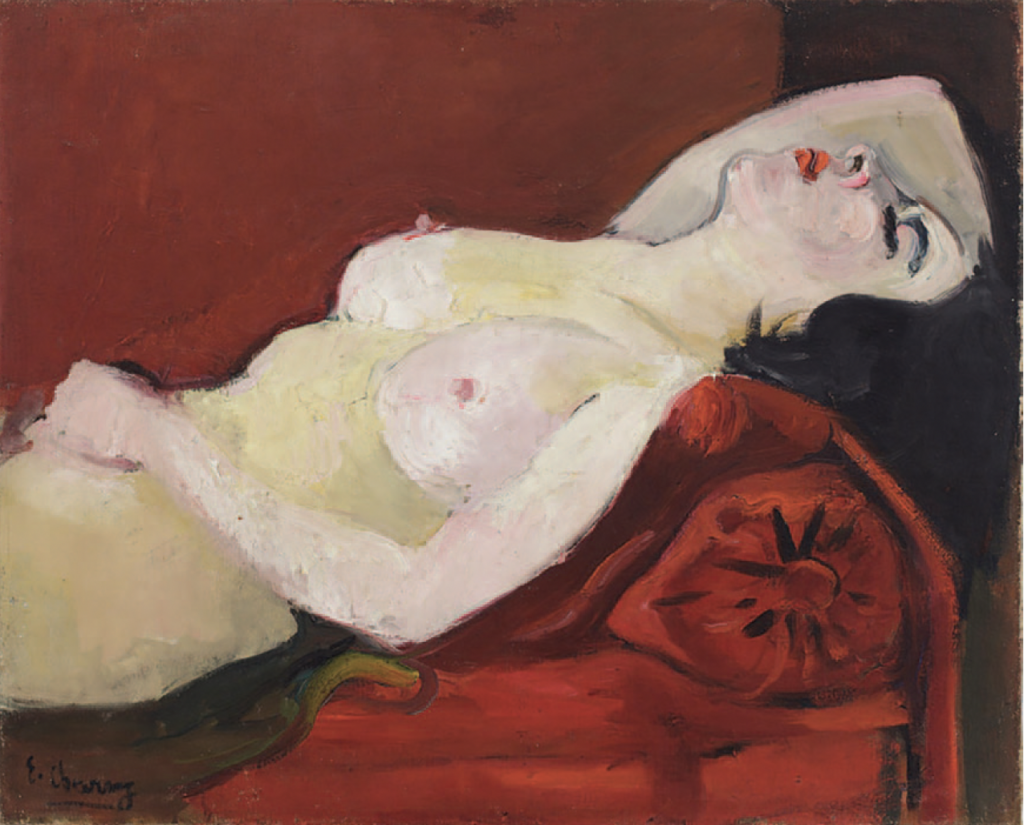
Émilie Charmy, Nu au divan rouge (Nude on Red Sofa) (c. 1925), oil on canvas, 31 1/2” x 25 3/4”. Private collection, © ADAGP, Paris / DACS, London
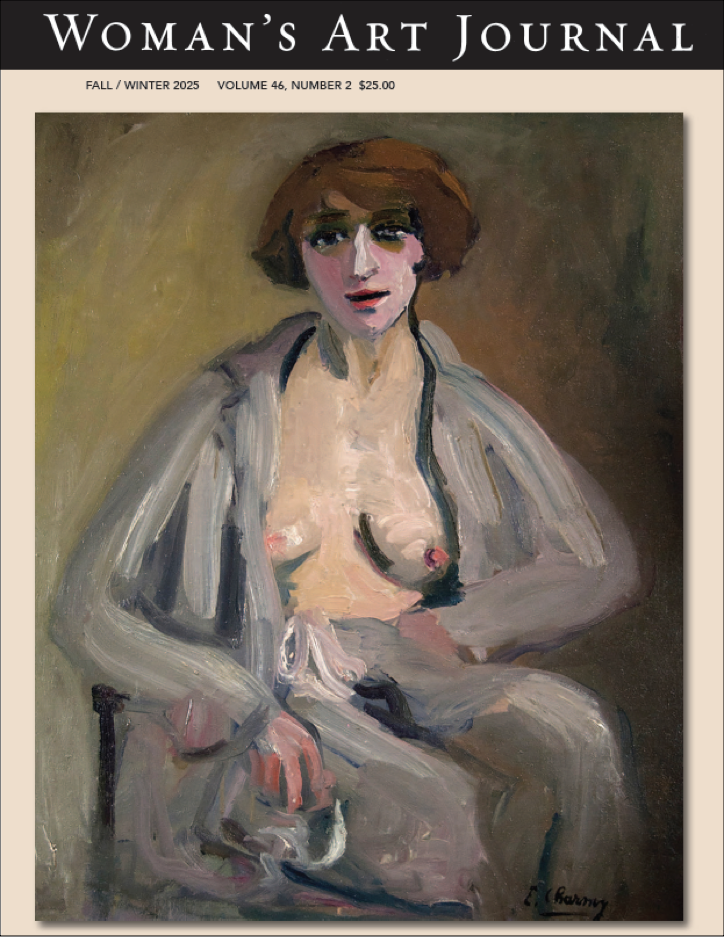
Émilie Charmy’s autonomous “sexual voice” commands our cover. For Charmy’s nude self-portrait (c. 1916–18), female sexuality is a pleasurable subject for the artist herself. In her 2023 book, Painting Her Pleasure: Three Women Artists and the Nude in Avant-Garde Paris, Lauren Jimerson completes her study on the overt sexuality of women artists of the École de Paris. For WAJ, Jimerson spotlights the daring, fiercely loyal art dealer Berthe Weill. Even with her own precarious economic standing, she favored the professional attention of women artists such as Suzanne Valadon and Charmy; her groundbreaking exhibition space, Galerie B. Weill, promoted the uncensored display of male and female nudes and bathers, thereby legitimizing the vanguard oeuvres by women artists, and financially supported them, in a radical departure from the moral values and obscenity laws of France. Jimerson wisely spent her years in Paris locating photographic archives that confirmed previously undocumented exhibitions installed at Weill’s gallery.
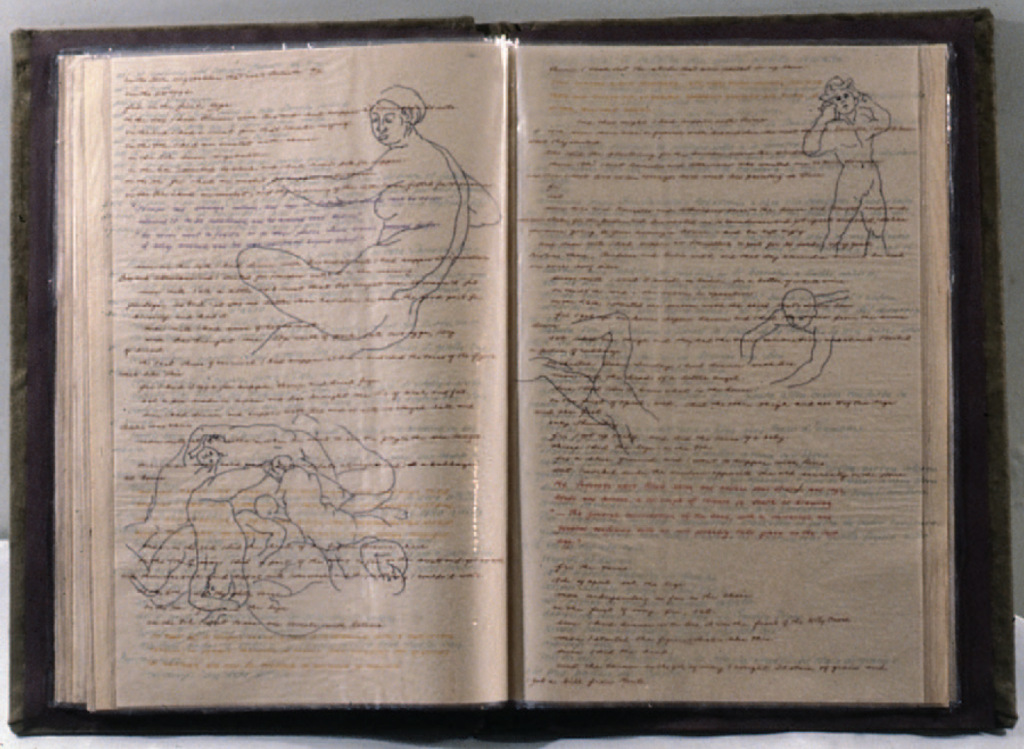
Rosemary Mayer, detail of Diary of Jacopo da Pontormo During the Time He Painted the Choir at San Lorenzo (1976). Handmade artist’s book; cover: green velveteen and paper bound with thread and satin ribbon; twenty-one pages: paper and vellum with ink encased in plastic, 20” x 14”. Courtesy of the Estate of Rosemary Mayer.
For Farren Fei Yuan, understanding the art of Rosemary Mayer inspires a deep critical investigation into the artist’s “disjunctive” relationship to her own time, one where she “adopted the precariousness” of Postminimalism and Conceptualism of the late 1960s and 1970s, and sought the past eras of Mannerism and the Baroque, to arrive at a new feminist sensibility of temporality and history. Departing from the primary scholarship on Mayer’s fabric sculptures and site-specific installations, Yuan turns to her “image-text” mixed-media pieces that work through unfixed artistic categories to strategically interact with the poetic articulations of her time. Not unlike Chryssa, Mayer’s works are rooted in women’s temporal “subjective experiences,” her own time-structures and indeterminacies shaped by socioeconomic forces on women’s daily lives. It is this “communicative exchange” between the artwork and audience, “straddling” conceptual contradictions and resisting capitalist productivity, Yuan writes, that propel the work’s existence.
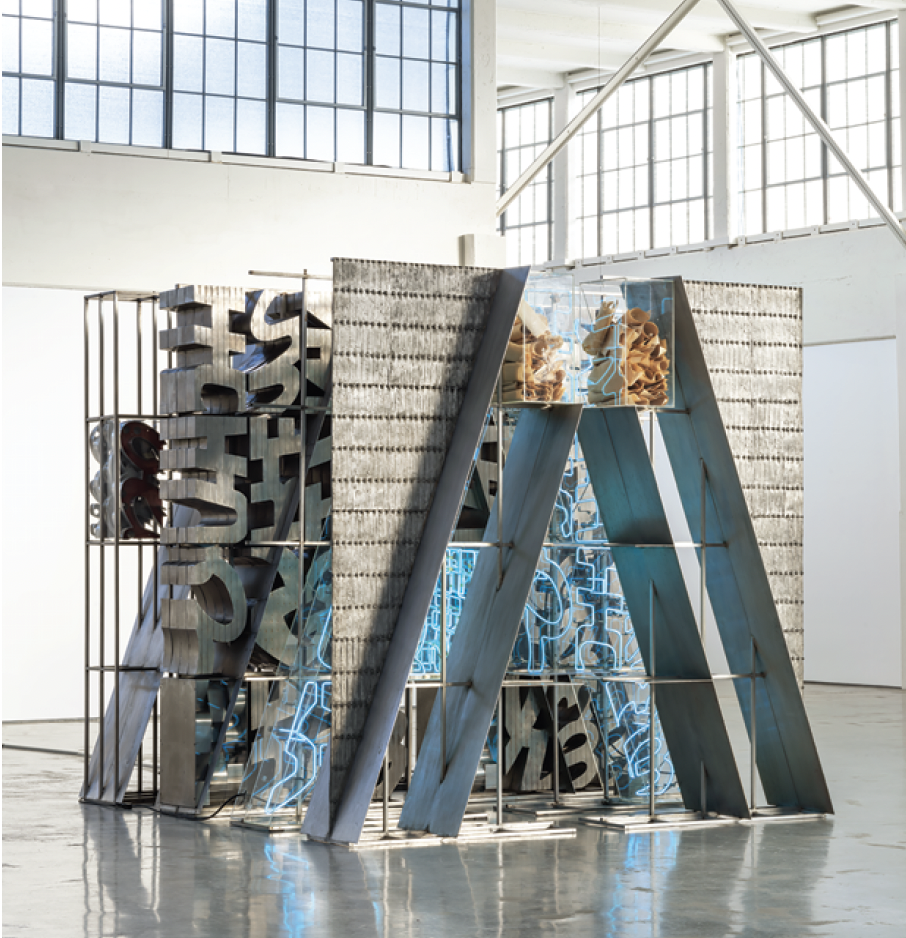
Chryssa, The Gates to Times Square (1964–66). Courtesy Buffalo AKG Art Museum. © Estate of Chryssa, National Museum of Contemporary Art Athens. Photo: Bill Jacobson Studio, New York. Image courtesy Dia Art Foundation.
Gemma Cirignano discusses Chryssa’s rapturous fascination with Times Square in the mid-1960s, the glitzy illumination and graphically seductive advertisements that inspired her extraordinary discipline to learn neon and transpose its craftsmanship into revelatory, abstract sculptures. Focusing on the cent sign and Chryssa’s masterpiece, The Gates to Times Square (1964–66), Cirignano explores how the artist harnessed the capitalist motives and “mechanisms of signage” in New York’s “commercial” center and exposes her precarity in doing so as an immigrant woman. By utilizing the “energy of the light itself,” in Chryssa’s words, she overcame her technical dependence on male labor to fabricate neon, later welding and assembling large-scale sculptures with temporary assistants.
We are immensely grateful to Melissa Mednicov for her keen editorial eye and seamless communication with thirteen international scholars to bring today’s most interesting books to our wider attention. Agnieszka Anna Ficek’s study on the obsessive eighteenth-century porcelain collecting practices of Western Europeans, and the fraught histories of Chinoiserie, centers the critical voices of Asian women. In early twentieth-century China, Meng Yi explores new cultural strategies for women’s national and global identification with modernity and the “domestic” arts. In her expert review of the visual legacies of Pre-Raphaelite Elizabeth Rossetti (Siddall), Susie Beckham sheds light on the often unreliable myths attached to the renowned model of Ophelia and offers new critical frameworks for Siddall’s scintillating life and growing artistic agency. Julia K. Dabbs covers three exceptional books devoted to the trailblazing lives of American women landscape painters: monographs on Fidelia Bridges and Susie M. Barstow, nineteenth-century artists whose landscape studies in nature created intimately “epic” views; and an ambitious transhistorical exhibition catalogue expanding the discourse, encompassing Bridges and Barstow, their contemporaries, and twentieth-century global multidisciplinary practitioners. Cross-generational interviews and Native feminist narratives are deliberated in Elizabeth S. Hawley’s two-book review on Indigenous artist and MacArthur genius-grant awardee Wendy Red Star (Apsáalooke Crow). Our examination of Indigenous identities continues in Jillian Russo’s dual coverage, both milestones: one focused on the curatorial and activist practices of the late Jaune Quick-to-See Smith in her major survey on other Native artists—curated by her—at the Zimmerli Art Museum at Rutgers, and the first monograph on Alaskan Sonya Kelliher-Combs.
Damon Reed returns to avant-garde Paris and expressions of modern female agency captured in the nude case studies of Charmy, Valadon, and Marie Vassilieff, masterfully illuminated by our lead author Lauren Jimerson. Dwelling in Paris, Jimerson explores the significant production and tumultuous biography of early twentieth-century sculptor and portraitist Chana Orloff, a Jewish émigré who navigated artistic communities and hybrid cultural identities in Montparnasse, Tel Aviv, and beyond. Catherine Hall-van den Elsen explores the wealth of quotidian and luxury objects in the collection of the MFA, Boston, that elucidate the daily lives of elite women in the Italian Renaissance. Elizabeth Catlett’s radical legacy is encapsulated by Funda Karayel. Kathleen James-Chakraborty examines the underrecognized yet productive careers of women at work in the fields of modern architecture and landscape design in the interwar and postwar decades. Visual art activism and reproductive rights “artivism” is amplified in the sweeping anthology reviewed by Karolina Majewska-Güde. Paulina Avila Esqueda enounces Tomashi Jackson’s sonic video projections and collages, vehicles of poetry, paintings, and joy. Lastly, Erin Devine praises the patronage of Eileen Harris Norton, whose extraordinary presence is elevated in this major collection catalogue.
Joan Marter and Aliza Rachel Edelman
Editors, Woman’s Art Journal
Parallel Perspectives
p. 2
By Joan Marter and Aliza Rachel Edelman
Portraits, Issues And Insights
p. 3
Curating Radicalism: Berthe Weill and the Women Who Redefined the Nude
By Lauren Jimerson
p. 15
“Words In Art Are Signs Returned”: Rosemary Mayer and the Poetics of Time
By Farren Fei Yuan
p. 32
Precarity In Pop: Chryssa’s Cent Sign
By Gemma Cirignano
Reviews
p.42
Monstrous Beauty: A Feminist Revision of Chinoiserie
Edited by Iris Moon
Reviewed by Agnieszka Anna Ficek
p. 45
Beyond Ophelia: The True Legacy of Elizabeth Eleanor Rossetti
By Glenda Youde
Reviewed by Susie Beckham
p. 49
Fidelia Bridges: Nature into Art
By Katherine Manthorne
Susie M. Barstow: Redefining the Hudson River School
By Nancy J. Siegel;
Women Reframe American Landscape: Susie Barstow & Her Circle
By Nancy Siegel, Kate Menconeri and Amanda Malmstrom
Reviewed by Julia K. Dabbs
p. 53
Wendy Red Star: Delegation
Contributions by Jordan Amirkhani, Julia Bryan-Wilson, Josh T. Franco, Annika K. Johnson, Layli Long Soldier, Tiffany Midge
Wendy Red Star: Bíilukaa
Conversations with Wendy Red Star, Wallace Red Star, Molly Malone, Chelsea Malone, Annika Johnson, and Adriana Greci Green
Reviewed by Elizabeth S. Hawley
p. 57
Indigenous Identities: Here, Now & Always
Edited by Jaune Quick-to-See Smith
Mark: Sonya Kelliher-Combs
Edited by Julie Decker
Reviewed by Jillian Russo
p. 60
Strong Women in Renaissance Italy
By Marietta Cambareri
Reviewed by Catherine Hall-van den Elsen
p. 62
Painting Her Pleasure: Three Women Artists and the Nude in Avant-Garde Paris
By Lauren Jimerson
Reviewed by Damon Reed
p. 64
Sculpting a Life: Chana Orloff between Paris and Tel Aviv
By Paula J. Birnbaum
Reviewed by Lauren Jimerson
p. 67
Women of Chinese Modern Art: Gender and Reforming Traditions in National and Global Spheres, 1900s–1930s
By Doris Sung
Reviewed by Meng Yi
p. 69
Elizabeth Catlett: A Black Revolutionary Artist and All That It Implies
Edited by Dalila Scruggs
Reviewed by Funda Karayel
p. 70
Women Architects at Work: Making American Modernism
By Mary Anne Hunting and Kevin D. Murphy
Reviewed by Kathleen James-Chakraborty
p. 73
Transnational Visual Activism for Women’s Reproductive Rights: My Body, My Choice
Edited by Basia Sliwinska
Reviewed by Karolina Majewska-Güde
p. 76
Tomashi Jackson: Slow Jamz
Edited by Mary Cason
Reviewed by Paulina Avila Esqueda
p. 77
All These Liberations: Women Artists in the Eileen Harris Norton Collection
Edited by Taylor Renee Aldridge
Reviewed by Erin C. Devine
Color Plates